
EDTA-ZnNa₂ Applications: Chelated Zinc Benefits

1. Introduction: Why EDTA-ZnNa₂ Matters
In modern industrial systems and advanced agriculture, the availability and stability of micronutrients-particularly zinc-play a critical role in performance, efficiency, and product quality.Among various zinc sources, EDTA-ZnNa₂ (Ethylenediaminetetraacetate Zinc Disodium) stands out as a highly effective chelated form, widely recognized for its stability, solubility, and controlled metal ion delivery.
Rather than acting as a simple zinc salt, EDTA-ZnNa₂ functions as a complexing agent, ensuring that zinc remains bioavailable even in challenging environments such as alkaline soils or metal-ion-rich industrial systems.
2. Chemical Identity and Properties
Chemical Name: Ethylenediaminetetraacetate Zinc Disodium
Molecular Formula: C₁₀H₁₂N₂Na₂O₈Zn
CAS Number: 14025-21-9
Appearance: White crystalline powder
Solubility: Highly soluble in water
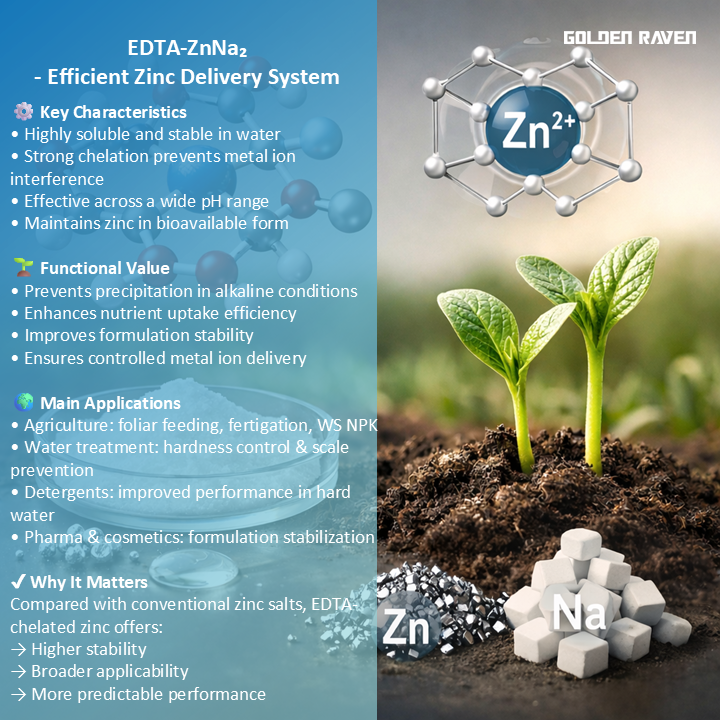
EDTA-ZnNa₂ is formed by the coordination of zinc ions (Zn²⁺) with the EDTA ligand, a well-known hexadentate chelating agent. This structure creates a stable ring-like complex, effectively protecting zinc ions from precipitation or unwanted reactions.
Key functional characteristic:👉 Maintains zinc in a chelated, bioavailable, and non-reactive form across a wide pH range
3. Core Functional Mechanism: Chelation
The defining feature of EDTA-ZnNa₂ is its chelating capability.
EDTA binds metal ions through multiple coordination sites
Prevents interaction with competing ions (Ca²⁺, Mg²⁺, Fe³⁺, etc.)
Enhances stability, solubility, and transport efficiency
This mechanism is critical in systems where free metal ions would otherwise:
Precipitate (e.g., Zn(OH)₂ in alkaline conditions)
React with other compounds
Lose effectiveness
4. Major Application Areas

4.1 Agriculture: Stable Zinc Nutrition
In agriculture, EDTA-ZnNa₂ is widely used as a micronutrient fertilizer, especially in:
Foliar fertilizers
Fertigation systems
Water-soluble NPK formulations
Key advantages:
Prevents zinc fixation in soil (especially alkaline/calcareous soils)
Improves zinc uptake efficiency
Supports enzyme activity, chlorophyll formation, and growth regulation
Compared with zinc sulfate (ZnSO₄), EDTA-chelated zinc:✔ Has higher bioavailability✔ Works effectively across broader pH ranges✔ Reduces nutrient loss
4.2 Food & Beverage Industry: Stability Control

In food systems, metal ions can catalyze:
Oxidation reactions
Color degradation
Flavor instability
Chelating agents like EDTA derivatives help:
Stabilize formulations
Extend shelf life
Maintain sensory quality
⚠️ Note:Use in food applications is strictly regulated (e.g., EU, FDA standards), and EDTA-ZnNa₂ is less common than CaNa₂EDTA in direct food use.
4.3 Pharmaceuticals: Formulation Stabilizer
In pharmaceutical formulations, EDTA-based compounds are used to:
Stabilize active ingredients
Prevent metal-catalyzed degradation
Improve product shelf life
They are commonly found in:
Injectable solutions
Eye drops
Complex formulations requiring metal control
4.4 Water Treatment: Metal Ion Control
EDTA-ZnNa₂ is used in water systems to:
Bind Ca²⁺ and Mg²⁺ (hardness control)
Prevent scale formation
Improve system efficiency
Typical applications:
Cooling water systems
Boiler treatment
Industrial wastewater
4.5 Detergents & Cleaning Products
In cleaning formulations, metal ions reduce detergent performance.
EDTA-ZnNa₂ helps by:
Sequestering hardness ions
Enhancing surfactant efficiency
Preventing residue formation
This results in:✔ Better cleaning performance✔ Improved fabric protection
4.6 Textile Industry
During dyeing and bleaching:
Metal ions can interfere with color consistency
Oxidative instability may occur
EDTA-ZnNa₂ functions as:
Bleach stabilizer
Color retention agent
Ensuring:✔ Uniform dye uptake✔ Improved fabric quality
4.7 Laboratory & Analytical Chemistry
In analytical chemistry, EDTA complexes are fundamental tools:
Used in complexometric titration
Applied in metal ion quantification
Essential in research involving coordination chemistry
4.8 Cosmetics & Personal Care

In cosmetics, EDTA derivatives:
Improve product stability
Prevent oxidation
Enhance shelf life
Commonly used in:
Shampoos
Creams
Lotions
5. Regulatory and Environmental Considerations
While EDTA-based compounds are highly effective, their use requires careful consideration:
Regulatory compliance (EU REACH, FDA, Codex standards)
Environmental persistence (EDTA is not readily biodegradable)
Controlled dosage and application
Modern trends are moving toward:👉 More biodegradable chelating agents (e.g., IDHA, GLDA)👉 But EDTA remains widely used due to its cost-performance balance and reliability
6. Conclusion
EDTA-ZnNa₂ is far more than a simple zinc source.It is a functional chelating system that enables:
Efficient micronutrient delivery in agriculture
Stability control in industrial and food systems
Performance enhancement across multiple sectors
Its versatility stems from a single core mechanism-metal ion chelation-which continues to make it indispensable in modern chemical and agricultural applications.


Comments