


Chelated Fertilizers: The Science Behind High-Efficiency Plant Nutrition
- Yang Wu
- 23 hours ago
- 5 min read

I. What Are Chelated Fertilizers?
The term “chelation” originates from a Latin root meaning “claw,” vividly describing the core mechanism of chelated fertilizers. Chemically, chelated fertilizers are a type of functional fertilizer in which inorganic medium and micronutrient elements are encapsulated by chelating agents, forming stable ring-like complex structures.
Chelating agents act like flexible “molecular claws.” They firmly bind metal nutrient ions, shielding them from antagonistic interactions with other ions in the soil, while also allowing for the gradual and controlled release of nutrients when crops require them. A typical example is EDTA (ethylenediaminetetraacetic acid), which forms a protective organic shell around micronutrient ions.
Once chelated, these nutrients are recognized by plants as readily absorbable forms and are actively taken up. Chelated fertilizers exhibit a unique chemical balance: the organic shell binds tightly to the inorganic nutrient but does not permanently fix it. This ensures that nutrients are protected from loss or soil fixation, yet can dissociate and become available for root and foliar absorption when needed.
From an industry standpoint, not all elements can form stable chelates. Currently, seven elements are widely recognized as suitable for stable chelation and agricultural use: zinc (Zn), iron (Fe), manganese (Mn), copper (Cu), calcium (Ca), magnesium (Mg), and boron (B). In contrast, macronutrients such as nitrogen (N), phosphorus (P), and potassium (K) cannot form stable, compliant chelated compounds and are not present in true chelated formulations.
Mainstream chelating agents on the market include EDTA series, DTPA series, EDDHA series, HEDP, and NTA. Each type is suited to different soil pH conditions and crop requirements, making the choice of chelating agent a key factor in determining product quality.
II. Key Differences Between Chelated Fertilizers and Conventional Inorganic Salts
Conventional inorganic micronutrient fertilizers tend to react quickly with phosphate ions, sulfate ions, and soil organic matter after application, forming insoluble precipitates. As a result, actual nutrient utilization by crops is often limited to only 20%-30%, with most nutrients becoming fixed and wasted.
Chelated fertilizers offer significant advantages. Once applied to the soil, chelated nutrients do not precipitate with other ions. Instead, they remain highly water-soluble and are readily absorbed by plant roots. When applied as foliar sprays, the organic outer layer allows nutrients to penetrate the waxy leaf surface efficiently, delivering nutrients directly into plant tissues. Overall nutrient use efficiency can be up to ten times higher than that of conventional inorganic salts.
Additionally, long-term use of traditional inorganic fertilizers may lead to soil salinity and toxicity, negatively affecting crop growth and food safety. In contrast, properly formulated chelated fertilizers are environmentally friendly, non-toxic, and leave no harmful residues. Their mild nature allows for safe application without long waiting periods before harvest-crops can often be safely harvested as early as the next day after application.
III. Core Functions and Agronomic Benefits of Chelated Fertilizers
1. Activation of Physiological Metabolism and Enhanced Photosynthesis
Chelated fertilizers activate enzymatic activity within plants, improve internal physiological cycles, and significantly enhance photosynthetic efficiency. This promotes dry matter accumulation and supports healthy growth, flowering, and fruiting.
2. Improved Stress Resistance
They enhance crop tolerance to drought, cold, heat, salinity, and lodging. At the same time, they strengthen plant immunity, suppress harmful pathogens, and reduce the incidence of physiological disorders and common pests and diseases, thereby lowering pesticide usage.
3. Balanced Nutrient Distribution for Stronger Growth
Chelating agents act as nutrient regulators within plants, optimizing the distribution of nutrients among roots, stems, leaves, flowers, and fruits. This helps prevent issues such as chlorosis, stunted growth, flower and fruit drop, and fruit cracking, ensuring uniform and vigorous plant development.
4. Soil Structure Improvement and Prevention of Compaction
Soil compaction is often caused by excessive application of conventional phosphate fertilizers, where phosphate ions bind with calcium and magnesium to form insoluble compounds, damaging soil structure. Chelated micronutrients prevent such antagonistic reactions, preserve soil structure, and promote beneficial microbial activity, enhancing soil fertility and sustainability.
5. Controlled Release and Labor Savings
Chelated fertilizers combine the long-lasting effect of organic fertilizers with the rapid response of functional fertilizers. With added growth-promoting substances and efficiency enhancers, they improve root-zone microecology and microbial activity. Nutrient release aligns with crop demand throughout the growth cycle. For crops like wheat, rice, and maize, a single basal application can meet full-season requirements. For crops like cucumbers, tomatoes, and peppers, the frequency of topdressing can be significantly reduced, saving labor and costs.
6. Yield Increase and Quality Enhancement
Proper use of chelated fertilizers can improve the overall utilization efficiency of N, P, and K by 20%-35% and extend fertilizer effectiveness. Under equivalent nutrient conditions:
Field crops can achieve yield increases of 15%–20%
Cash crops (fruits, vegetables, medicinal plants) can increase yields by 15%–30%
At the same time, crop quality improves-higher starch and protein content in grains, better sugar content, color uniformity, fruit shape, and post-harvest storage performance-leading to higher market value and competitiveness.
IV. Application Fields of Chelated Fertilizers
Field Crops: Wheat, rice, maize, sorghum-applied as basal fertilizer to promote strong seedlings, tillering, and high yields.
Cash Crops: Fruit trees, vegetables, tea, flowers, medicinal plants-used to correct deficiencies, improve quality, and reduce flower/fruit drop.
Landscaping and Horticulture: Trees, ornamentals, lawns-enhance plant vigor, prevent chlorosis, and maintain long-term aesthetic quality.
V. Main Application Methods
Basal Application: Evenly broadcast before sowing or transplanting and incorporate into soil for long-term nutrient release.
Root Application: Applied during growth via banding, hole placement, or fertigation for rapid nutrient uptake.
Foliar Spray: Diluted 500–1000 times and sprayed during calm morning or evening periods for quick correction of deficiencies.
VI. Core Product Portfolio
1. EDDHA Fe 6%
Highly stable iron chelate, especially suitable for alkaline and calcareous soils. Effectively prevents and corrects iron chlorosis, widely used in fruit trees, vegetables, and ornamentals.
2. Full EDTA Chelate Series
Versatile, highly soluble, and ideal for fertilizer blending:
EDTA Acid: Base raw material for chelate production
EDTA-2Na / EDTA-4Na: General-purpose chelating agents
EDTA-CaNa₂: Prevents fruit cracking, improves firmness
EDTA-CuNa₂: Enhances metabolism and disease resistance
EDTA-FeNa: Rapid correction of mild iron deficiency
EDTA-MgNa₂: Supports chlorophyll synthesis
EDTA-MnNa₂: Regulates redox processes
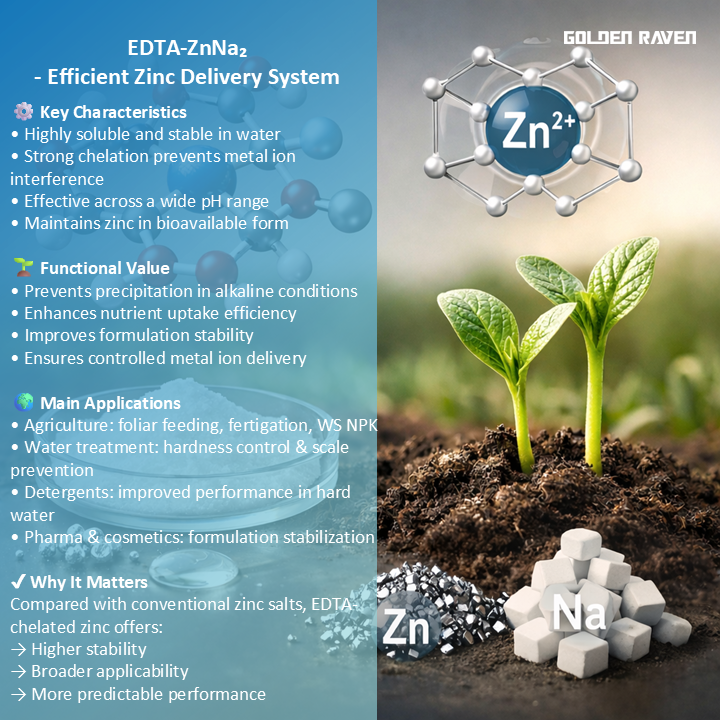
EDTA-ZnNa₂: Promotes root growth and fruit development
3. DTPA-FeHNa
Excellent solubility and stability across a wide pH range. Rapidly corrects iron deficiency and significantly improves crop growth and yield.
All chelated fertilizer products comply with international quality standards and are supported by REACH registration. Produced using advanced manufacturing processes and strict quality control, they feature high purity, excellent solubility, no residue, and no caking.
Whether for large-scale farming, smallholder agriculture, or horticultural applications, these products provide standardized solutions and professional fertilization programs-supporting stable yields, improved quality, and increased agricultural profitability.

Chelated Fertilizers: The Science Behind High-Efficiency Plant Nutrition


Comments