
How to Distinguish Base Fertilizer, Starter Fertilizer, Seedling Fertilizer, and Topdressing?

Every spring planting season, questions like this come up repeatedly: “We’ve already applied autumn fertilizer. Now that we are entering the spring sowing stage, should we still add fertilizer with the first irrigation?”
On the surface, this question is about whether to fertilize or not. But in essence, it is asking: what role does each type of fertilizer play at different stages, when should it be applied, and why?
Once the application timing, functional focus, and supporting practices of base fertilizer, starter fertilizer, seedling fertilizer, and topdressing are clearly understood, many practical fertilization challenges in the field can be easily resolved.
From a practical agricultural perspective, fertilization is never simply about “applying more” or “applying less.” It depends on the crop growth stage, root development status, soil nutrient-supplying capacity, as well as local cultivation and irrigation conditions.
Different fertilizers serve different purposes at different stages. Only by clarifying these relationships can fertilization become more targeted and effective in achieving stable seedlings, vigorous growth, higher yields, and improved quality.
I. Base Fertilizer: The Nutritional Foundation of the Entire Growth Cycle
(1) Core Definition
Base fertilizer, also known as basal fertilizer, refers to fertilizers applied to the soil before sowing or transplanting, or around the end of the growing season for perennial crops, in combination with soil preparation and tillage practices.
It is not intended for short-term “emergency supplementation,” but rather to establish a stable nutrient foundation for the entire growth cycle. Therefore, it is often regarded as the “foundation layer” of crop nutrition.
Compared with fertilizers applied during later growth stages, its key characteristics are: early application, long duration of effect, and dual functions of soil improvement and nutrient supply.
(2) Core Functions
Providing full-cycle nutrient support
The primary role of base fertilizer is to supply nitrogen, phosphorus, potassium, and secondary/micronutrients throughout the entire crop growth cycle. It helps maintain a relatively stable nutrient environment for root systems, especially as nutrient demand changes over time, preventing noticeable nutrient depletion in later stages.
Improving soil physical and chemical properties
Base fertilizer systems with a higher proportion of organic inputs not only supply nutrients but also increase soil organic matter, improve soil structure, and enhance water retention, nutrient retention, and buffering capacity. For soils that are poor, compacted, or low in fertility, the value of base fertilizer lies not only in “feeding the crop” but also in “building the soil.”
Enhancing utilization of low-mobility nutrients
Nutrients such as phosphorus and potassium have limited mobility in soil. If applied only in later stages, their efficiency is often low. By incorporating them into the main root zone in advance, crops can gradually absorb them, reducing losses and improving utilization.
However, base fertilizer also has limitations. Because it is usually applied deeper and more evenly distributed, early-stage seedlings with shallow root systems cannot fully utilize it immediately. This is why relying solely on base fertilizer is often insufficient in practical field management.
(3) Scientific Application Methods
Application timing
Typically applied 7–15 days before sowing or transplanting. For perennial crops such as fruit trees and forage grasses, it is often applied in autumn or at the end of the growing season. This allows sufficient time for interaction with the soil and reduces risks of localized high concentrations.
Fertilizer selection strategy
Base fertilizer mainly consists of organic fertilizers such as compost, manure, and well-decomposed farmyard manure, supplemented with slow-release phosphorus and potassium fertilizers. Nitrogen fertilizers may be added in moderate amounts depending on soil fertility. The overall principle is stability and long-term effectiveness.
Common application methods
Broadcasting + plowing: evenly spread on the soil surface and incorporated into 15–30 cm depth, suitable for crops with dense planting and extensive root systems (e.g., wheat, rice).
Band or hole application: placed near planting rows or holes, suitable for row crops such as maize or where fertilizer use is limited.
Layered application: slower-acting materials (organic matter, humic substances) placed deeper, while faster-acting fertilizers are applied in shallower layers for staged root uptake.
(4) Fertilizer Types Suitable for Base Application
Organic fertilizers / soil conditioners
Such as potassium humate (K-Humate) and potassium fulvate (K-Fulvate). These improve soil structure and nutrient retention, especially when combined with organic inputs.
Phosphorus and potassium base fertilizers
Such as Diammonium Phosphate (DAP 21-53-0) and Monoammonium Phosphate (MAP 12-61-0). High in phosphorus, suitable for base or deep placement to support root development and later reproductive growth.
Secondary and micronutrient fertilizers
Such as Potassium Sulfate (SOP 00-00-50/52) and Magnesium Sulfate (MgSO₄·H₂O), particularly useful in nutrient-deficient soils and when combined with organic fertilizers.
II. Starter Fertilizer: The “Initial Nutrient Package” for Seedlings
(1) Core Definition
Starter fertilizer is applied near the seed or simultaneously during sowing or transplanting. Its purpose is not to support the entire growth cycle, but to help seedlings pass through the critical early growth stage, especially the nutrient-sensitive “weaning period.”
Essentially, starter fertilizer acts as a “nutritional starter pack”—small in quantity but concentrated, fast-acting, and safe.
(2) Core Functions
Promoting uniform and vigorous seedling establishment
Adequate early nutrient supply, especially phosphorus, supports root development and improves uniformity.
Reducing transplant shock and adaptation period
For transplanted crops, it provides readily available nutrients to help seedlings recover faster.
Enhancing early stress resistance
Supplementing micronutrients such as zinc and boron can improve tolerance to low temperature, drought, and other stresses.
However, starter fertilizer requires careful management. Since most fertilizers contain salts, excessive concentration or proximity to seeds can cause seed burn or root damage.
(3) Scientific Application Methods
Timing
Must be applied simultaneously with sowing or at transplanting. Early application may lead to nutrient loss, while late application fails to meet critical early needs.
Selection principles
Choose fertilizers with low salt index, fast availability, good stability, and minimal volatilization. Avoid ammonia water, ammonium bicarbonate, or high-chloride fertilizers near seeds.
Common methods
Layered placement: maintaining a 5–8 cm safe distance between fertilizer and seeds.
Seed coating or soaking: using diluted micronutrients like boric acid or zinc sulfate.
Root dipping: for transplanted crops, enhancing early establishment.
(4) Fertilizers Suitable as Starter Fertilizer
High-phosphorus soluble fertilizers
Such as Monopotassium Phosphate (MKP 0-52-34), promoting root development.
Low-nitrogen, high-phosphorus fertilizers
Such as MAP (12-61-0), offering fast phosphorus supply with relatively low risk.
Micronutrient fertilizers
Such as Boric Acid (H₃BO₃) and Zinc Sulfate (ZnSO₄·7H₂O), used for seed treatment or localized application.
III. Seedling Fertilizer: Rapid Support During Early Growth
(1) Core Definition
Seedling fertilizer is applied after emergence, typically during the early leaf stage (1–4 leaves). It serves as a transitional nutrient supply, addressing the gap before roots fully develop.
(2) Core Functions
Filling early nutrient gaps
Promoting further root expansion
Preventing early deficiency symptoms
(3) Application Methods
Fertigation
Foliar spraying
Light localized application
(4) Suitable Fertilizers
Calcium Ammonium Nitrate (CAN)
MKP and Urea Phosphate (UP)
EDTA chelated micronutrients
IV. Topdressing: Precision Nutrient Supply at Key Growth Stages
(1) Core Definition
Topdressing refers to fertilizers applied during crop growth according to stage-specific nutrient demand. It is the key factor determining yield and quality.
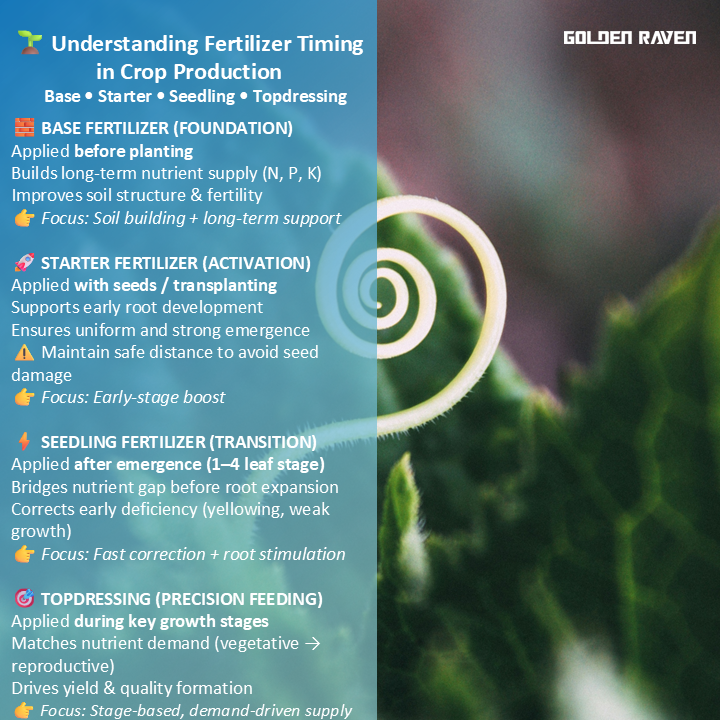
Base fertilizer = foundationStarter fertilizer = initiationSeedling fertilizer = transitionTopdressing = precision supply
(2) Core Functions
Meeting peak nutrient demand
Enhancing stress resistance
Improving yield and quality
(3) Application Methods
Soil application
Fertigation
Foliar feeding
(4) Suitable Fertilizers
Potassium Nitrate (KNO₃ 13.5-0-46)
MKP, SOP
Cal-Mag, EDDHA-Fe
V. Summary: The Difference Is More Than Timing
The distinction between these four fertilizers is not just about when they are applied, but also about their functional roles, characteristics, and management objectives.
(1) Core Differences
Base fertilizer → foundation and soil improvement
Starter fertilizer → early-stage support
Seedling fertilizer → gap-filling and recovery
Topdressing → demand-driven supply
(2) General Principles
Base fertilizer → focus on long-term effect and soil building
Starter fertilizer → focus on safety and quick response
Seedling fertilizer → focus on flexibility and rapid correction
Topdressing → focus on precision and stage matching
Conclusion: Fertilization Is Not About “Whether,” but “How Well”
Returning to the original question:“We already applied autumn fertilizer — should we still add fertilizer during spring irrigation?”
The answer is not simply “yes” or “no.” It depends on:
Whether base fertilizer was sufficient
Whether starter fertilizer was applied
Current seedling condition
Soil nutrient supply capacity
Irrigation and cultivation conditions


Comments