


Sodium Tripolyphosphate (STPP): A Multifunctional Additive in Food and Industrial Systems
- Yang Wu
- Mar 11
- 6 min read

Within the family of phosphate compounds, Sodium Tripolyphosphate (STPP) is a highly representative multifunctional inorganic salt. Owing to its stable chemical structure and excellent chelating, dispersing, and buffering properties, it plays an important role in both food processing and a wide range of industrial applications.
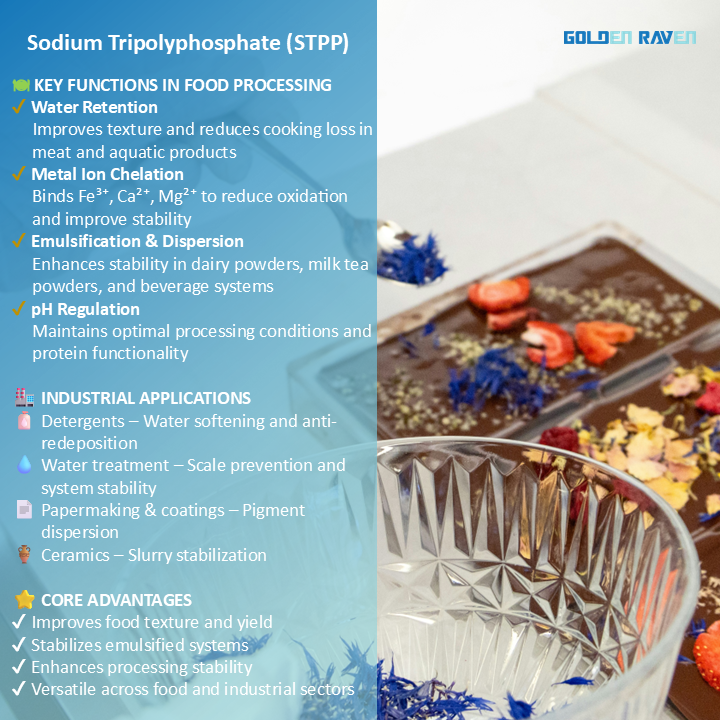
In the food industry, STPP is commonly used as a water-retention agent, chelating agent, and emulsifying stabilizer, significantly improving food structure and processing stability.
In industrial sectors, it functions as a water softener, dispersant, and suspending agent, and is widely used in detergent manufacturing, ceramic processing, water treatment, papermaking, and coatings production.
Its functional value is particularly prominent in food processing. STPP can effectively improve the yield and texture of meat and aquatic products, delay the staling of baked goods, reduce precipitation and phase separation in dairy products, improve the color stability of fruit and vegetable products, and enhance the uniformity and stability of compound beverage systems. For this reason, in many food technology publications, STPP is often described as a “structure regulator in modern food processing.”
In addition, as a widely recognized food additive, STPP has been incorporated into food safety regulatory systems in many countries and international organizations and is used under strict quality standards and usage guidelines.
📌 This article focuses on food-grade Sodium Tripolyphosphate, systematically introducing its chemical structure, physicochemical properties, production processes, and core functional roles. It also discusses typical application scenarios and briefly reviews its uses in non-food industrial sectors to help industry readers develop a more comprehensive and systematic understanding.
I. Basic Understanding: Definition, Structure, and Key Properties
1.1 Definition and Nomenclature
Sodium Tripolyphosphate (STPP) is a typical inorganic polyphosphate compound, with the chemical formula Na₅P₃O₁₀. Within the phosphate family, it belongs to a class of linear polymers formed by the condensation of multiple phosphate units through dehydration reactions.
The term “tripoly” refers to the presence of three phosphate groups in the molecular structure, which are linked through oxygen bridges to form a chain-like structure. The “five sodium” designation indicates that five sodium ions are present in the molecule to maintain overall charge balance and stabilize the structure.
Due to its excellent chemical stability and multifunctional characteristics, STPP is widely used across multiple industries. Depending on application requirements and quality standards, it is generally classified into:
Food-grade STPP
Industrial-grade STPP
Although their chemical compositions are essentially identical, there are significant differences in raw material purity, impurity control, and quality standards.
1.2 Chemical Structure Characteristics
The molecular structure of sodium tripolyphosphate consists of three PO₄³⁻ tetrahedral units connected by oxygen bridges to form a linear chain. This structure not only provides stability but also creates multiple active coordination sites capable of participating in chelation reactions.
Because of this structural feature, STPP can effectively form stable complexes with metal ions such as Ca²⁺, Mg²⁺, and Fe³⁺. In food systems, this property helps reduce oxidation reactions catalyzed by metal ions and also modifies the spatial structure of proteins, making them more capable of binding water.
Therefore, during food processing, STPP exhibits multiple functional roles, including water retention, dispersion, emulsification, and stabilization of system structure, which explains its extensive industrial application.
1.3 Main Physicochemical Properties
Property Item | Description |
Appearance | White crystalline powder, odorless |
Molecular Weight | 367.86 g/mol |
CAS Number | 7758-29-4 |
Solubility | Easily soluble in water; solubility about 20 g/100 mL at 20 °C |
pH (1% solution) | 9.0–10.0, weakly alkaline |
Melting Point | Approximately 622 °C (decomposes at this temperature) |
Chelating Ability | Forms stable complexes with various metal ions |
Thermal Stability | Stable at room temperature; gradually hydrolyzes under heating or acidic conditions |
These physicochemical properties give STPP excellent stability and versatility in both food processing and industrial production.
1.4 Crystal Forms: Anhydrous and Hexahydrate Types
In practical production and applications, sodium tripolyphosphate mainly exists in two forms:
Anhydrous STPP
Hexahydrate STPP (STPP·6H₂O)
Comparison Item | Anhydrous STPP | Hexahydrate STPP |
Chemical Formula | Na₅P₃O₁₀ | Na₅P₃O₁₀·6H₂O |
Moisture Content | ≤0.5% | About 24% crystal water |
Appearance | Dry white powder | Slightly moist powder |
Stability | Good stability, low hygroscopicity | More hygroscopic |
Main Application | Food industry | Detergents and industrial uses |
Processing Adaptability | More suitable for high-temperature processing | Suitable for wet systems |
📌 In food processing applications, anhydrous STPP is usually preferred to avoid the influence of excess moisture on product flowability and stability.
II. Production Process and Quality Standards of Food-Grade STPP
Although food-grade and industrial-grade STPP share the same chemical structure, there are significant differences in raw material sources, impurity control, and production management.
In the food industry, STPP is not only a functional additive but also a raw material that must strictly comply with food safety standards. Therefore, production requires high-purity raw materials and strict control of heavy metals and other impurities.
Key Differences Between Food-Grade and Industrial-Grade STPP
Item | Food-Grade STPP | Industrial-Grade STPP |
Raw Materials | High-purity phosphoric acid and food-grade alkaline substances | Industrial phosphoric acid or recycled materials |
Impurity Control | Strict limits on heavy metals such as lead, arsenic, and fluorine | Relatively relaxed impurity control |
pH Characteristics | Suitable for food systems | Usually strongly alkaline |
Certification Requirements | ISO22000, HALAL, REACH, etc. | Generally no food certification required |
Application Fields | Food processing | Detergents, water treatment, etc. |
Overview of the Production Process
The production of food-grade STPP generally involves the following steps:
1. Neutralization Reaction
Phosphoric acid reacts with sodium carbonate or sodium hydroxide to produce a mixture of sodium dihydrogen phosphate and disodium hydrogen phosphate.
2. Dehydration and Condensation
Under high-temperature conditions of 300–500 °C, dehydration and condensation reactions occur:
3. Cooling and Granulation
By controlling cooling speed and drying conditions, products of different particle sizes can be obtained, and either anhydrous or hydrated forms can be produced according to requirements.
III. Core Functions of Food-Grade STPP in Food Processing
As a typical functional polyphosphate, STPP not only improves structural stability in food systems but also enhances product quality and processing efficiency.
1️⃣ Water Retention and Tenderizing Effect
STPP can form complexes with metal ions in muscle proteins, thereby modifying protein structure and enhancing its water-binding capacity.
Typical applications include:
Application | Function |
Ham, sausages | Reduce cooking loss |
Meatballs, dumpling fillings | Improve elasticity |
Surimi products | Improve molding properties |
2️⃣ Metal Ion Chelation
STPP can bind metal ions such as Fe³⁺ and Cu²⁺, thereby:
Slowing down lipid oxidation
Preventing discoloration
Improving food system stability
This is particularly important in high-mineral systems such as milk powder and cheese powder.
3️⃣ Emulsification and Dispersion Performance
STPP can improve the stability of emulsified systems by regulating pH and calcium ion concentration.
Typical applications:
Product | Function |
Milk tea powder | Improve dispersibility |
Milk powder | Inhibit crystallization |
Non-dairy creamer | Improve emulsion stability |
4️⃣ pH Regulation
STPP solutions are weakly alkaline and can adjust system pH to the range of 6.5–7.5.
Its functions include:
Promoting protein solubility
Improving thermal stability
Reducing microbial risk
📌 Typical dosage
Usually 0.2%–0.5%, depending on food regulations and formulation design.
IV. Extended Applications of STPP in Industrial Fields
Although this article focuses on food-grade STPP, its applications in industrial sectors are also extensive.
1️⃣ Toothpaste Industry
In toothpaste formulations, STPP plays the following roles:
Inhibiting tartar formation
Improving abrasive dispersion
Enhancing cleaning performance
2️⃣ Detergent Industry
STPP is an important auxiliary ingredient in traditional detergents.
Function | Role |
Water softener | Removes Ca²⁺ and Mg²⁺ |
Dispersant | Prevents redeposition of dirt |
pH buffer | Maintains washing system stability |
3️⃣ Water Treatment and Papermaking
In industrial applications, STPP is also commonly used for:
Preventing pipeline scaling
Improving slurry dispersion
Enhancing pigment stability
V. Selection Recommendations for Anhydrous vs Hexahydrate STPP
Application | Recommended Form |
Food additives | Anhydrous |
Milk powder | Anhydrous |
Detergents | Hexahydrate |
Ceramic slurry | Hexahydrate |
📌 In the food industry, anhydrous STPP is more widely used.
VI. Regulatory Compliance and International Standards
Region | Regulation |
🇨🇳 China | GB2760 |
🇪🇺 European Union | E451(i) |
🇺🇸 United States | 21 CFR §182.1810 |
🌍 CODEX | INS451(i) |
Conclusion: Scientific Use of STPP to Improve Food Processing Quality
As an important functional phosphate, Sodium Tripolyphosphate (STPP) plays an irreplaceable role in modern food processing. Through its water-retention, emulsification, chelation, and pH-regulating functions, it can effectively improve food texture and enhance processing stability.
Core Advantages of Food-Grade STPP
Improves food texture
Enhances water retention capacity
Stabilizes emulsified systems
Improves processing stability
Principles for Safe Use
1️⃣ Use food-grade products2️⃣ Strictly control dosage levels3️⃣ Ensure compatibility within formulations
Final Message from Golden Raven
Sodium Tripolyphosphate (STPP) remains one of the most versatile phosphate additives used in modern food processing.
Through regulatory compliance and scientifically designed formulations, STPP can significantly enhance food structure and processing stability while ensuring safety and quality.
Golden Raven supplies high-purity food-grade STPP and supports partners worldwide with:
• Customized packaging
• Full documentation support
• Regulatory and analytical assistance
• Product samples for testing


Comments