
Choosing the Right Potassium Fertilizer: A Practical Guide to KNO₃, MKP, MOP, and SOP

Potassium (K) is one of the three primary macronutrients essential for crop growth. It plays a critical role in photosynthesis, nutrient transport, enzyme activation, and stress resistance, directly influencing crop yield, fruit quality, lodging resistance, and disease tolerance. Selecting the right potassium fertilizer and applying it correctly is therefore essential for maximizing productivity and crop quality.
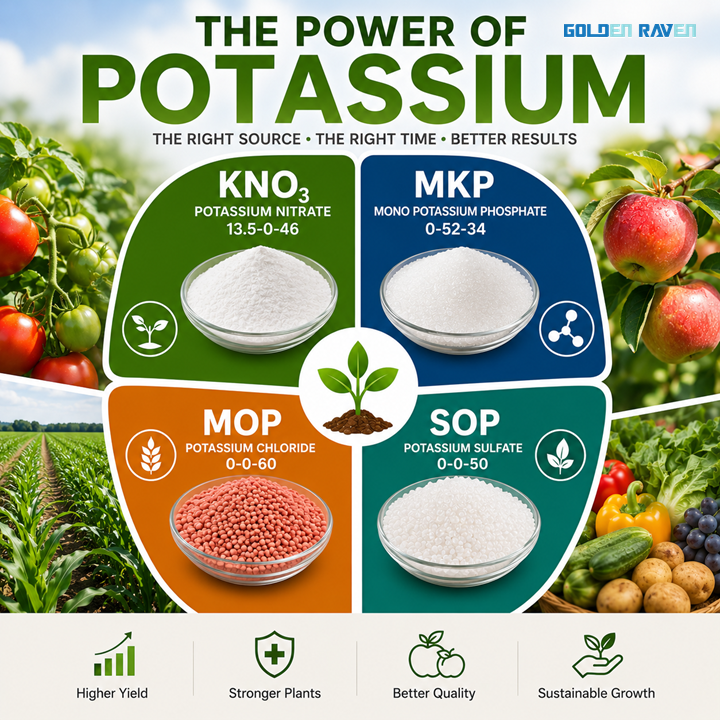
Among the many potassium fertilizers available today, four products are most commonly used in agricultural production: Potassium Nitrate (KNO₃), Mono Potassium Phosphate (MKP), Potassium Chloride (MOP/KCl), and Potassium Sulfate (SOP/K₂SO₄). Each has distinct nutrient characteristics, application scenarios, and limitations. Understanding these differences helps growers optimize fertilizer efficiency, avoid nutrient imbalances, and achieve better economic returns.
1. Potassium Nitrate: A Fast-Acting Nitrogen-Potassium Fertilizer for Fruit Enlargement
Potassium nitrate is a highly efficient nitrogen-potassium fertilizer containing approximately 13.5% nitrate nitrogen (N) and 46% potassium oxide (K₂O). It is chemically neutral, highly water-soluble, and readily absorbed by plants. Long-term use generally does not contribute to soil acidification or compaction, making it suitable for most upland soils.
Best Application Stage
Potassium nitrate is most effective during the early and middle stages of fruit enlargement. The nitrate nitrogen promotes vegetative growth and cell expansion, while potassium supports fruit development and increases fruit weight.
Key Limitation
It should not be applied during fruit coloring and ripening stages. Excess nitrate nitrogen can inhibit anthocyanin synthesis, resulting in delayed coloration, uneven ripening, green shoulders, and reduced market quality.
Application Recommendations
Suitable for fertigation, side-dressing, and foliar spraying.
Not recommended as a basal fertilizer due to its high solubility and relatively high cost.
Not suitable for flooded rice paddies because nitrate nitrogen is highly susceptible to leaching.
2. Mono Potassium Phosphate (MKP): A Premium Phosphorus-Potassium Fertilizer for Quality Improvement
Mono Potassium Phosphate (MKP, 0-52-34) is a high-purity, water-soluble phosphorus-potassium fertilizer containing approximately 52% P₂O₅ and 34% K₂O. It is chemically neutral, low in impurities, and rapidly absorbed by plants.
Due to its versatility, MKP is widely used in cereals, fruits, vegetables, ornamentals, and greenhouse crops.
Key Growth Stages for Application
Before and During Flowering
Promotes root development.
Encourages flower bud differentiation.
Reduces flower and fruit drop.
Improves fruit set.
Fruit Enlargement and Coloring Stage
Enhances sugar accumulation.
Improves fruit coloration.
Increases sweetness and overall fruit quality.
Post-Harvest Recovery
Replenishes nutrients rapidly.
Promotes shoot maturation and lignification.
Improves cold and drought tolerance.
Supports next season's productivity.
Potassium Nitrate vs. MKP: How to Choose?
Many growers struggle to decide between potassium nitrate and MKP. Neither is universally superior; the choice depends on crop growth stage and nutrient demand.
1. Nutrient Focus
Potassium Nitrate
Nitrogen + Potassium
Promotes vegetative growth and fruit enlargement
MKP
Phosphorus + Potassium
Promotes flowering, fruit set, coloration, and quality improvement
2. Recommended Growth Stage
Potassium Nitrate
Rapid vegetative growth
Fruit enlargement
MKP
Flower bud differentiation
Flowering and fruit setting
Fruit coloring and ripening
Post-harvest recovery
3. Application Scope
Potassium Nitrate
Not suitable for paddy fields
Avoid during fruit coloring
MKP
Suitable for virtually all crops and soil types
Can be used throughout the crop cycle
4. Application Method
Both fertilizers are premium, fast-acting products and are best used through:
Fertigation
Drip irrigation
Foliar spraying
Supplemental top-dressing
They can also be used strategically in combination to provide balanced phosphorus, nitrogen, and potassium nutrition.
3. Potassium Chloride (MOP): The Most Cost-Effective Potassium Fertilizer
Potassium chloride (KCl), commonly known as MOP (Muriate of Potash), is the most widely used potassium fertilizer globally. Commercial products typically contain 50-60% K₂O and appear as white, light yellow, or reddish crystals depending on impurity levels.
Because of its relatively low cost and high potassium concentration, it is extensively used in large-scale field crop production.
Recommended Application Rates
Basal Application
120–150 kg/ha
Top Dressing
75–105 kg/ha
Foliar Spray
0.5–1.0% solution
Major Limitation: Chloride Sensitivity
Potassium chloride should not be used on chloride-sensitive crops such as:
Tobacco
Potato
Sweet potato
Watermelon
Banana
Cherry
Lettuce
Green beans
Excess chloride may reduce sugar accumulation, starch formation, and overall product quality.
Soil Restriction
Avoid application on saline or sodic soils, where chloride accumulation can worsen salinity problems.
Special Advantage
Potassium chloride performs exceptionally well on:
Cotton
Hemp
Other fiber crops
It promotes photosynthesis and fiber development, helping improve both yield and fiber quality.
4. Potassium Sulfate (SOP): The Premium Choice for Chloride-Sensitive Crops
Potassium sulfate (SOP) is a chloride-free potassium fertilizer with a theoretical K₂O content of approximately 54%, while most commercial products contain around 50% K₂O.
It is highly soluble, relatively non-hygroscopic, and easy to store and handle. Chemically neutral but physiologically acidic, SOP is widely regarded as the preferred potassium source for high-value horticultural and specialty crops.
Suitable Crops
Fruits
Vegetables
Potatoes
Grapes
Citrus
Melons
Other chloride-sensitive crops
Recommended Application Rates
Basal Application
150–180 kg/ha
Top Dressing
75–105 kg/ha
Foliar Spray
0.5–1.0% solution
Best Application Timing
SOP is particularly effective during the late growth stages, especially from fruit coloring through maturity.
Benefits include:
Enhanced fruit coloration
Increased sugar accumulation
Improved fruit appearance
Better storage quality
Higher market value
Long-Term Considerations
Continuous exclusive use of SOP may gradually lower soil pH, contributing to soil acidification.
In orchards, prolonged heavy application may increase the availability of manganese in acidic soils, potentially leading to manganese toxicity symptoms such as:
Leaf chlorosis
Premature tree decline
Reduced vigor
To maintain soil health, growers should periodically apply:
Organic matter
Agricultural lime
Other soil amendments
to balance soil acidity and improve long-term fertility.
Quick Guide: Which Potassium Fertilizer Should You Choose?
Choose Potassium Chloride (MOP) When:
✔ Growing chloride-tolerant field crops such as rice, wheat, cotton, and fiber crops✔ Cost-efficiency is the primary concern
Choose Potassium Nitrate (KNO₃) When:
✔ Crops are in vigorous vegetative growth✔ Fruit enlargement is the primary objective✔ Additional nitrogen is required
Choose Mono Potassium Phosphate (MKP) When:
✔ Promoting flowering and fruit set✔ Improving fruit coloration and sweetness✔ Supporting post-harvest recovery✔ Enhancing crop quality throughout the season
Choose Potassium Sulfate (SOP) When:
✔ Growing chloride-sensitive crops✔ Improving fruit quality during maturation✔ Producing high-value fruits and vegetables
Conclusion
No single potassium fertilizer is ideal for every crop or growth stage. The most effective strategy is to match the fertilizer type to the crop's nutritional requirements, growth phase, soil conditions, and production goals. By selecting the right potassium source and applying it at the appropriate time and rate, growers can maximize fertilizer efficiency, improve crop quality, and achieve stable, high-yield production.
Choosing the Right Potassium Fertilizer: A Practical Guide to KNO₃, MKP, MOP, and SOP


Comments