
MKP and Grapes: A Proven Combination for Quality and Yield

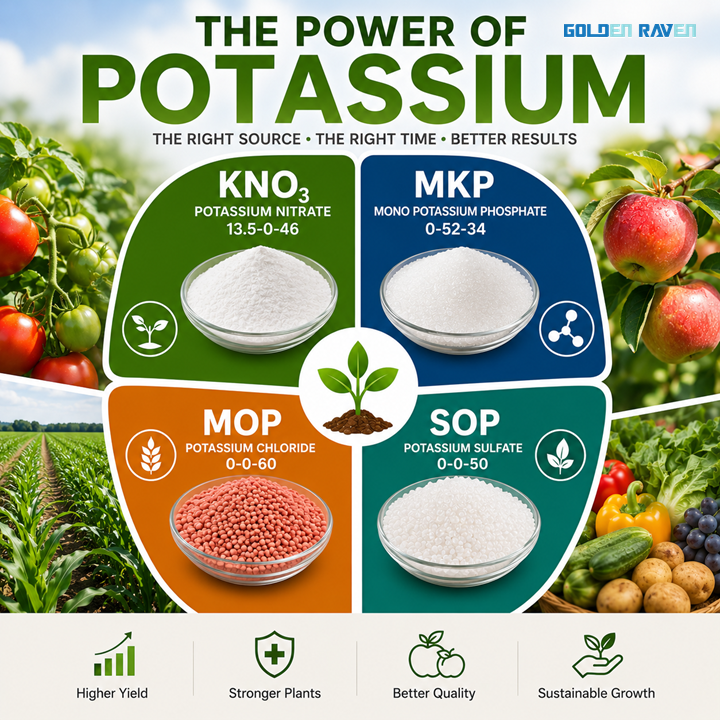
Grapes, often referred to as the “fruit of sunshine,” are cultivated worldwide in a wide range of varieties, flavors, and growing environments. Achieving high yields and premium fruit quality depends largely on balanced plant nutrition, with phosphorus (P) and potassium (K) playing essential roles throughout the entire growth cycle. This article explores the value of Mono Potassium Phosphate (MKP, 0-52-34) in grape production and provides practical recommendations for its application.
I. Essential Environmental Requirements for Grapes
Grape growth, yield, and fruit quality are influenced by five key factors: light, temperature, water, soil, and nutrition.
1. Light
Light is the driving force behind photosynthesis and directly affects sugar accumulation and fruit ripening.
Annual sunshine duration should exceed 1,500 hours.
During the growing season, grapes require at least 6 hours of sunlight per day.
Adequate sunlight promotes vigorous vine growth, strong flower bud differentiation, and superior fruit quality.
Insufficient light can lead to excessive shoot growth, flower and fruit drop, poor coloration, and reduced sugar content.
Excessive exposure to intense sunlight may cause sunburn damage on berries.
2. Temperature
Grapes are warm-season crops, with different temperature requirements at each growth stage.
Bud break: Above 10°C; temperatures below 0°C may damage buds.
Shoot growth and flowering: 20–30°C is optimal; cool, rainy weather can reduce pollination success and increase fruit drop.
Fruit ripening: 20–32°C is ideal; temperature extremes may result in poor coloration, lower sugar levels, and increased sunburn.
Most commercial vineyards are located between 30° and 50° latitude in both hemispheres. Temperature can also be moderated through mulching, vineyard orientation, and altitude selection.
3. Water
Water is involved in all physiological processes of grapevines.
Adequate moisture is essential during bud break for uniform emergence.
Excessive rainfall during flowering may cause flower drop.
Fruit enlargement is the period of highest water demand.
Moderate water restriction from veraison to harvest can improve sugar accumulation and flavor concentration.
Both prolonged drought and excessive soil moisture can reduce yields and increase disease pressure.
4. Soil
Well-drained sandy loam soils are preferred.
Optimal soil pH: 6.0–7.5
Excessively acidic soils may induce magnesium deficiency.
Alkaline soils can reduce iron and zinc availability.
Heavy clay soils are prone to waterlogging and root diseases.
Saline and highly sandy soils often require improvement to enhance nutrient and water retention.
5. Basic Nutrient Requirements
Nitrogen, phosphorus, and potassium are the three primary nutrients required by grapevines.
Nutrient | Main Function | Deficiency Symptoms | Impact |
Nitrogen (N) | Shoot growth and chlorophyll formation | Yellowing young leaves, stunted growth | 15–20% yield reduction and lower photosynthetic efficiency |
Phosphorus (P) | Root development, flowering, energy transfer | Darkened older leaves, weak clusters, poor fruit set | Reduced fruit set and poor fruit development |
Potassium (K) | Sugar transport and stress tolerance | Leaf scorch, soft berries, low sugar content | Lower Brix and up to 25% higher fruit cracking risk |
II. Key Vineyard Establishment Techniques
Successful vineyard establishment depends on three major aspects: propagation, trellis system, and planting management.
1. Propagation Methods
Rooted Cuttings
Advantages
Lower production cost
Faster establishment
Fruiting can begin in the second year
Limitations
Shallow root system
Lower resistance to cold and soil-borne diseases
Grafted Vines
Advantages
Strong root development
Improved disease and cold tolerance
Better adaptation to challenging soils
Limitations
Longer nursery production cycle
Commercial yields typically begin in the third year
Requires professional grafting skills
2. Trellis Systems
Y-Trellis
Excellent canopy distribution
Uniform light interception
Suitable for mechanized operations
Commonly used for table grape varieties such as Kyoho and Summer Black
V-Trellis
Suitable for high-density planting
Supports high yields
Widely used for premium varieties such as Shine Muscat
Requires careful canopy ventilation to reduce disease pressure
3. Planting Management
Spring planting is generally preferred in northern regions.
Autumn planting is often recommended in southern regions.
Recommended planting trench dimensions:
Depth: 50–60 cm
Width: 80–100 cm
A typical planting profile includes:
Straw layer at the bottom to improve aeration
Well-composted organic fertilizer combined with MKP in the middle layer to stimulate root establishment
After planting:
Apply sufficient irrigation immediately.
A 0.1% MKP solution may be added to support root development.
Pinch shoots when they reach approximately 80 cm to encourage strong vine architecture.
III. Phosphorus and Potassium: The Foundation of High-Quality Grapes
Phosphorus and potassium perform different functions but work synergistically to improve grape productivity and quality.
1. Phosphorus – The Energy Driver
Phosphorus promotes:
Root growth
Flower bud differentiation
Pollen development
Energy transfer within the plant
Phosphorus deficiency often results in:
Weak root systems
Small flower clusters
Poor fruit set
Increased flower and berry drop
Critical application periods:
Bud break
Flowering
Fruit enlargement
2. Potassium - The Quality Enhancer
Potassium:
Improves photosynthetic efficiency
Accelerates sugar transport into berries
Promotes anthocyanin synthesis
Enhances skin strength
Improves stress resistance
Potassium deficiency may cause:
Leaf margin scorch
Uneven berry coloration
Reduced storage life
Lower sugar accumulation
Critical application periods:
Fruit enlargement
Veraison (color change)
Fruit maturation
3. Phosphorus-Potassium Synergy and the Advantages of MKP
During fruit enlargement, grapevines absorb more than 50% of their annual phosphorus and potassium requirements.
MKP provides phosphorus and potassium in a highly efficient ratio that closely matches vine demand during this critical stage.
Compared with conventional fertilizers, MKP offers several advantages:
Fully water-soluble with rapid nutrient uptake
Suitable for fertigation and foliar spraying without clogging irrigation systems
Chloride-free, making it ideal for chloride-sensitive crops such as grapes
Safe for use on saline and alkaline soils
Supplies both phosphorus and potassium in a single product, reducing fertilizer applications and labor costs
Mild and compatible with most pesticides and foliar fertilizers
IV. Precision MKP Fertigation Program Throughout the Growing Season
1. Autumn Base Fertilization (Reserve Building)
Apply:
Well-composted organic fertilizer
MKP at 15-20 kg per acre (approximately 37–50 kg/ha)
Deep band application is recommended.
Benefits:
Promotes vine recovery after harvest
Supports bud differentiation
Enhances winter hardiness
Improves root vitality
2. In-Season Fertigation Program
Growth Stage | Objective | MKP Application | Combination | Expected Benefit |
Bud Break | Strong shoot and flower development | Fertigation + 0.2% foliar spray | Humic acid | Uniform bud break and increased flower clusters |
Fruit Enlargement | Berry growth and crack prevention | Fertigation + 0.3% foliar spray every 7 days | Calcium polyol formulations | Larger berries and reduced cracking |
Veraison | Sugar accumulation and coloration | Fertigation + 0.5% foliar spray | Amino-acid foliar fertilizer | Improved sweetness and uniform color development |
Practical Guidelines
Maintain fertigation concentrations below 0.2%.
Monitor soil salinity regularly.
Apply foliar sprays during the late afternoon or evening.
Ensure good coverage of the leaf undersides.
3. Stress Recovery Applications
Spring Frost Events
Apply:
0.2% MKP
Brassinolide
Benefits:
Improves cold tolerance
Supports recovery from frost damage
After Prolonged Rainfall
Apply MKP as a foliar spray to:
Improve plant vigor
Enhance disease resistance
Reduce susceptibility to downy mildew
4. Common Application Mistakes to Avoid
Avoid excessive concentrations, especially during hot weather.
Reduce spray concentration under high-temperature conditions to prevent leaf burn.
Do not mix MKP with strongly alkaline pesticides.
Maintain an interval of at least 72 hours between applications.
For long-term use, monitor soil pH regularly and correct excessive acidity when necessary.
Conclusion
Successful grape production relies on understanding vine physiology and supplying nutrients at the right time and in the right form. Among all nutrient inputs, phosphorus and potassium remain the cornerstone of stable yields, premium fruit quality, and improved vineyard profitability.
Thanks to its high nutrient efficiency, excellent solubility, chloride-free formulation, and broad compatibility, Mono Potassium Phosphate (MKP 0-52-34) has become one of the most effective phosphorus-potassium fertilizers for modern grape production.
When integrated into a well-planned nutrition program, MKP helps growers produce grapes with larger berries, higher sugar content, better coloration, stronger stress resistance, and superior market value.

MKP and Grapes: A Proven Combination for Quality and Yield

Comments