
Monopotassium Phosphite (MKPI): How Does It Differ from Monopotassium Phosphate?

When discussing phosphorus and potassium products, many growers first think of monopotassium phosphate (MKP). Another product with a similar name - monopotassium phosphite (MKPI) - is also attracting attention.
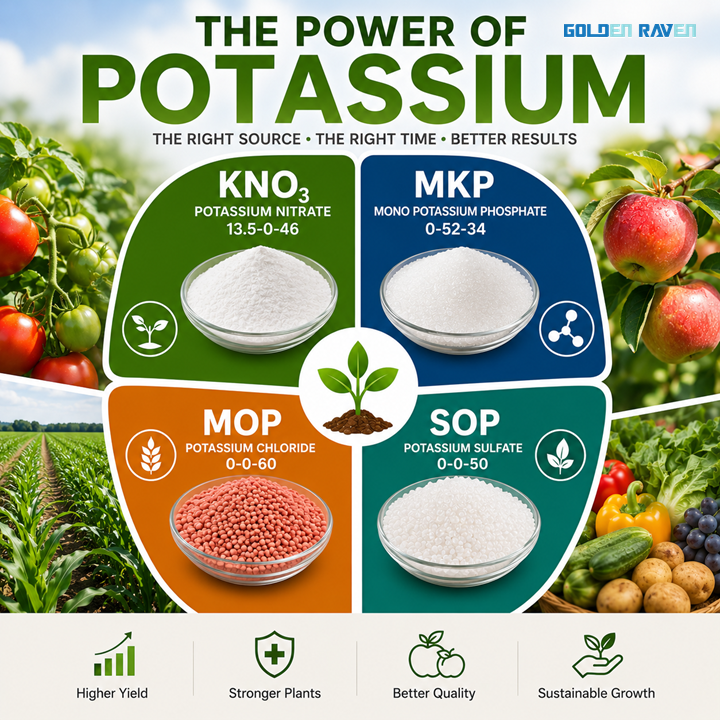
MKP is commonly labelled 0-52-34, while MKPI is often marketed as 0-58-38. These figures may suggest that MKPI contains “more phosphorus and potassium,” but nutrient percentages alone do not explain how the two products work.
The key is to distinguish phosphite from phosphate.
1. Product Identity and Physicochemical Properties
Monopotassium phosphite is an inorganic potassium salt commonly abbreviated as MKPI. Some suppliers also use the abbreviation MPP.
Parameter | Basic Information |
Chemical formula | KH₂PO₃ |
CAS number | 13977-65-6 |
Molecular weight | Approximately 120.09 g/mol |
ECHA list number | 604-162-9 |
Phosphorus oxidation state | +3 |
Typical appearance | White crystals or crystalline powder |
Water solubility | Readily soluble in water |
Aqueous solution | Generally acidic; pH depends on composition and concentration |
Its substance identity can be found in ECHA records. However, inclusion in a chemical database does not establish authorization for agricultural use.
Which Quality Parameters Matter?
The following values are illustrative commercial specifications taken from the supplied information and require verification. Published specifications should match the manufacturer’s Technical Data Sheet (TDS) and batch Certificate of Analysis (COA).
Test Parameter | Illustrative Specification |
KH₂PO₃ content | ≥ 98.0% |
Phosphorus, expressed as P₂O₅ | ≥ 58.0% |
Potassium, expressed as K₂O | ≥ 38.0% |
pH of a 1% aqueous solution | 3.8 – 4.0 |
Water-insoluble matter | ≤ 0.3% |
Chloride, expressed as Cl⁻ | ≤ 0.01% |
For formulation development, moisture, free acid, phosphate impurities and relevant elemental contaminants should also be considered. Assay methods and reporting bases must be clearly defined: a total phosphorus result should not automatically be treated as a measurement of monopotassium phosphite purity.
High water solubility makes solution preparation convenient, but does not guarantee compatibility at every concentration, temperature or mixing condition. Quantitative solubility data should state the test temperature and specify whether the result refers to a litre of water or a litre of solution.
2. One Oxygen Atom Makes a Major Difference
Monopotassium phosphate has the formula KH₂PO₄, while monopotassium phosphite is KH₂PO₃.
Although they differ by only one oxygen atom, the chemical form of phosphorus is different:
MKP: phosphate phosphorus, with phosphorus in the +5 oxidation state.
MKPI: phosphite phosphorus, with phosphorus in the +3 oxidation state.
Conventional crops can use phosphate for energy metabolism, nucleic acid synthesis and growth. Phosphite cannot directly perform the same nutritional role.
Therefore, MKPI cannot replace conventional phosphate fertilizers such as MKP or MAP. Although soil microorganisms can gradually convert phosphite into phosphate, this is not a reliable means of supplying phosphorus when crops need it.
3. What Does “0-58-38” Mean?
The commercial designation “0-58-38” generally indicates no nitrogen, approximately 58% phosphorus expressed as P₂O₅, and approximately 38% potassium expressed as K₂O.
A crucial distinction is:
The “58” is a phosphorus oxide-equivalent value, not a measure of phosphorus directly available for normal crop nutrition.
P₂O₅ and K₂O are reporting conventions. They do not mean that these oxides are physically present in the product at those percentages.
When evaluating a product, check its actual composition, phosphorus form, purity and batch test results alongside the headline specification.
4. Why Is Phosphite Attracting Attention?
Movement Within the Plant
Once absorbed, phosphite can move through both the xylem and phloem. This mobility is an important basis for its use in specific plant protection programs.
Actual distribution depends on the crop, application method and growth conditions. Mobility alone does not guarantee that every plant tissue receives an effective concentration.
Value in Specific Disease Management Programs
Phosphite activity can include direct inhibition of certain pathogens and stimulation of plant defence responses. Relevant applications primarily involve oomycete pathogens, including Phytophthora and Pythium.
Performance depends on the crop, pathogen, formulation, dose and application timing. It should not be presented as effective against every disease. Disease-control uses must follow locally authorized product labels.
A Source of Soluble Potassium
MKPI supplies soluble potassium. However, potassium content alone does not guarantee higher sugar levels, firmer fruit or increased yields. Results depend on crop nutrient status, application rate and overall management.
5. MKPI vs. MKP: Choosing for the Intended Purpose
Comparison | MKPI: Monopotassium Phosphite | MKP: Monopotassium Phosphate |
Chemical formula | KH₂PO₃ | KH₂PO₄ |
Phosphorus form | Phosphite | Phosphate |
Common commercial designation | 0-58-38 | 0-52-34 |
Conventional phosphorus nutrition | Cannot replace phosphate fertilisers | Supplies phosphorus usable by crops |
Main value | Phosphite properties and specific plant protection uses | Phosphorus and potassium nutrition |
Basis for use | Product authorization, label and validated program | Crop nutrient requirements and formulation conditions |
Before selecting a product, define the objective: supplying phosphorus and potassium nutrition, or evaluating a specific phosphite program. A clear purpose helps prevent confusion between two similarly named products.
6. Tank Mixing: Solubility Does Not Guarantee Compatibility
A readily soluble product is not necessarily compatible with every fertilizer or pesticide.
Check both product labels before mixing, paying particular attention to copper products, strongly alkaline materials and formulations containing calcium, magnesium or other metal ions. Some copper product labels specifically prohibit mixing with phosphite products.
A practical assessment involves two steps:
Jar test: Check for precipitation, flocculation, separation or an unusual temperature rise.
Small-scale crop trial: Assess tolerance of leaves, young shoots and roots.
A clear mixture does not prove that it is safe for the crop. Application concentration, frequency and intervals should follow the product label and a validated program.
7. Packaging, Storage and Market Access
Packaging should provide appropriate moisture protection. Keep the product sealed in a cool, dry, well-ventilated location, protected from moisture, contamination and packaging damage.
Handling precautions, hazard classification and transport requirements should follow the current Safety Data Sheet (SDS) applicable to the product.
For international trade, chemical compliance and agricultural market authorization must be assessed separately. For example, Regulation (EU) 2019/1009 prohibits the intentional addition of phosphonates to EU fertilising products. MKPI therefore cannot simply be marketed as a conventional CE-marked fertiliser under that framework. Other market routes and plant protection uses require separate assessment.
Clearly explaining its physicochemical properties, phosphorus form and conditions of use helps buyers and growers understand where monopotassium phosphite fits.

Monopotassium Phosphite: How Does It Differ from Monopotassium Phosphate?

Comments