
Phosphorus Chemical Industry Chain: From Rocks to Fertilizers

I. Industry Overview
The phosphorus chemical industry is a strategic pillar of China's chemical sector, playing a critical role in both national food security and the rapidly expanding new energy industry. Centered on phosphate rock as its primary raw material, the industry produces a wide range of phosphorus-containing products through two main processing routes: the wet-process and thermal-process technologies. These products serve agriculture, industrial manufacturing, food and pharmaceuticals, electronics, semiconductors, energy storage, and many other sectors.
Today, China's phosphorus chemical industry is undergoing a significant transformation. While traditional agricultural demand for phosphate fertilizers continues to grow steadily, the rapid expansion of the new energy sector, particularly lithium iron phosphate (LFP) battery materials - is reshaping the industry. As a result, the sector is evolving from a fertilizer-focused industry into a dual-engine growth model driven by both agricultural demand and advanced energy materials.
The total market value of China's phosphorus chemical industry exceeded RMB 280 billion in 2024 and is projected to reach RMB 420 billion by 2030, representing a compound annual growth rate (CAGR) of approximately 6.5%.
The industry's product portfolio can be broadly divided into two major categories:
Agricultural products, including phosphate fertilizers and phosphorus-based agrochemicals, which support global food production.
Industrial products, including high-purity phosphates, electronic-grade phosphoric acid, and specialty phosphorus compounds that support advanced manufacturing and clean energy technologies.
II. The Complete Phosphorus Chemical Industry Chain

1. Upstream: Raw Materials and Energy
The upstream segment is built around phosphate rock, sulfur, sulfuric acid, and silica, supported by energy inputs such as electricity and coke. Production facilities typically include acid treatment systems, purification units, and specialized chemical processing equipment.
Phosphate Rock Resources
As a non-renewable strategic mineral resource, phosphate rock distribution is highly concentrated worldwide:
Global phosphate rock reserves are estimated at approximately 74 billion tonnes.
Morocco alone holds around 50 billion tonnes, accounting for approximately 67.6% of global reserves.
China possesses roughly 3.8 billion tonnes, representing approximately 5.1% of global reserves and ranking second worldwide.
More than 90% of China's phosphate resources are concentrated in four provinces:
Yunnan (36%)
Hubei (25%)
Sichuan (18%)
Guizhou (13%)
A significant supply-demand imbalance exists globally. Although China holds only about 5.1% of global reserves, it accounts for approximately 40.9% of global phosphate rock production, with annual mining volumes reaching around 90 million tonnes. In contrast, resource-rich countries such as Morocco and Saudi Arabia possess abundant reserves but comparatively lower production levels, with substantial capacity expansion underway.
Raw Material Cost Pressure
More than 70% of China's phosphate rock consumption is used for fertilizer production, while the remaining 30% supports higher-value sectors such as:
Yellow phosphorus
High-purity phosphates
Battery precursor materials
Specialty phosphorus chemicals
Recent surges in sulfur prices and disruptions in import supply chains have significantly increased upstream production costs, accelerating the industry's push toward technological upgrades and resource efficiency.
2. Midstream: Processing Technologies and Product Manufacturing
The midstream sector converts phosphate rock into phosphoric acid and yellow phosphorus, which serve as the primary intermediates for the entire phosphorus chemical value chain.
Two major processing routes dominate the industry:
(1) Wet-Process Phosphoric Acid (Mainstream Technology)
Wet-process phosphoric acid is produced by reacting phosphate rock with sulfuric acid.
Depending on the crystallization form of calcium sulfate, several process variations exist, including:
Dihydrate process
Hemihydrate process
Current industry structure in China:
Approximately 85% of production capacity uses the mature and cost-effective dihydrate process.
Around 15% employs advanced hemihydrate technology capable of producing higher-concentration phosphoric acid directly.
The primary challenge associated with wet-process production is the generation of phosphogypsum, a large-volume industrial by-product. Efficient utilization and treatment of phosphogypsum remain among the industry's most important environmental and sustainability priorities.
(2) Thermal-Process Phosphoric Acid
Thermal-process phosphoric acid is produced by smelting phosphate rock, coke, and silica at high temperatures to produce elemental phosphorus, followed by oxidation and hydration.
Key characteristics:
High energy consumption
Significant environmental constraints
Higher production costs
Superior product purity
Due to its economics, thermal-process phosphoric acid is increasingly reserved for specialty applications and high-end phosphorus chemicals.
Major Midstream Products and Applications
Phosphoric Acid
Available in:
Industrial Grade
Food Grade
Electronic Grade
Applications include:
Phosphate salt synthesis
Food acidulants
Semiconductor wafer cleaning and etching
Surface treatment chemicals
As the central intermediate of the phosphorus industry chain, phosphoric acid forms the foundation for numerous downstream products.
These high-analysis phosphate fertilizers are widely used across global grain, oilseed, and cash crop production systems.
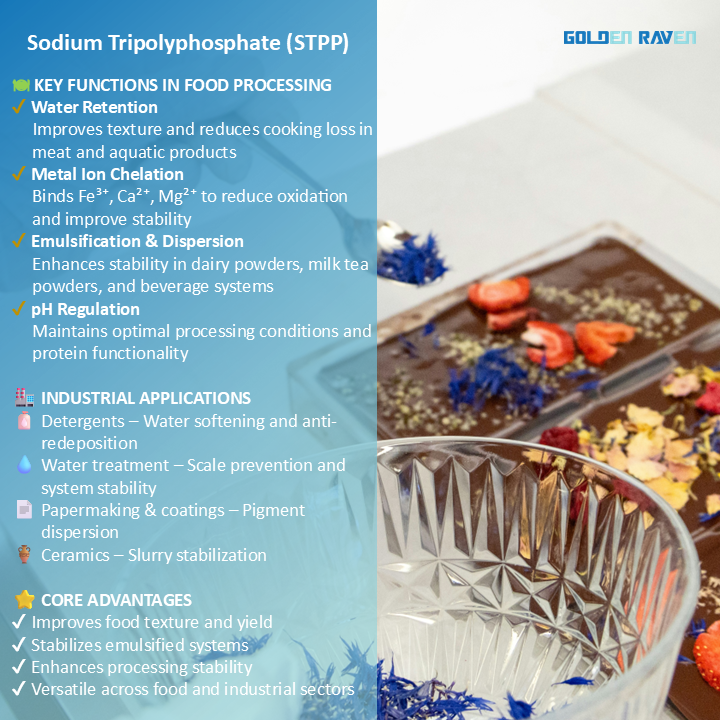
Sodium Tripolyphosphate (STPP) and Sodium Hexametaphosphate (SHMP)
Widely used in:
Detergents
Water softening
Papermaking
Water treatment
Food preservation and moisture retention
Dicalcium Phosphate (DCP)
Applications include:
Animal feed
Food additives
Pharmaceuticals
Toothpaste formulations
Organophosphorus Compounds
Used in:
Crop protection chemicals
Water treatment chemicals
Textile auxiliaries
Specialty industrial applications
3. Downstream: End-Use Markets
The downstream market is increasingly characterized by a dual-demand structure:
Traditional Agriculture
Core applications include:
Phosphate fertilizers
Glyphosate herbicides
Additional markets include:
Detergents
Water treatment
Pharmaceuticals
Flame retardants
Plastic additives
Demand in these sectors remains relatively stable and resilient.
Emerging New Energy Sector
The rapid growth of electric vehicles and energy storage systems has created substantial demand for:
Iron phosphate
Lithium iron phosphate (LFP)
This segment has become the industry's most significant growth engine.
III. Analysis of Key Market Segments
1. Phosphate Fertilizers
Phosphate fertilizers remain indispensable to global food production.
Industry statistics:
China's phosphate fertilizer output reached 16.15 million tonnes in 2023, up 6.1% year-on-year.
Production increased to approximately 16.16 million tonnes in 2024, maintaining stable growth.
Product Structure
High-concentration phosphate fertilizers account for approximately 96.6% of total output.
MAP and DAP dominate production and collectively represent roughly two-thirds of global output, reinforcing China's position as the world's largest phosphate fertilizer producer.
Market Outlook
Driven by global food security concerns and increasing agricultural productivity requirements, global phosphate fertilizer demand is expected to grow at approximately 3.5% annually, with the market projected to exceed USD 90 billion by 2030.
2. Glyphosate
Glyphosate is the world's most widely used broad-spectrum herbicide.
Industry data:
China's glyphosate output reached approximately 530,000 tonnes in 2023.
Production recovered to around 580,000 tonnes in 2024.
Global production capacity is estimated at approximately 1.18 million tonnes, with China maintaining a dominant position.
More than 80% of China's glyphosate production is exported, serving key agricultural markets across:
North America
Europe
Asia-Pacific
India
Southeast Asia
Demand growth remains strong in emerging agricultural economies.
3. Lithium Iron Phosphate (LFP)
Lithium iron phosphate has become the leading cathode material for:
Electric vehicle batteries
Energy storage batteries
Its rapid expansion is transforming the phosphorus chemical industry.
Market Growth
China's lithium battery shipments:
887.4 GWh in 2023 (73.8% of global share)
1,175 GWh in 2024 (78.6% of global share)
China continues to dominate global battery production.
Demand Outlook
Global LFP demand is expected to exceed 3 million tonnes by 2028, with a CAGR of approximately 25%, making it one of the fastest-growing segments within the phosphorus value chain.
Industry Integration
Leading Chinese phosphorus producers are increasingly establishing fully integrated supply chains:
Phosphate Rock → Phosphoric Acid → Iron Phosphate → Lithium Iron Phosphate
This integration strengthens cost competitiveness and secures China's position as a key global supplier of battery materials.
IV. Trade Dynamics and Industry Development Trends
1. Evolving Global Trade Structure
As Morocco, Saudi Arabia, and other resource-rich countries continue expanding phosphate mining capacity, the global phosphate supply landscape is becoming increasingly diversified.
Industry forecasts suggest:
China's share of global phosphate fertilizer exports may decline from approximately 30% today to around 25% by 2030.
Southeast Asia will become an increasingly important export destination.
China's phosphate fertilizer exports to Southeast Asia are expected to rise from 41% of total exports in 2023 to approximately 53% by 2030.
2. Three Major Industry Trends
High-End Product Development
Demand for advanced products such as:
Electronic-grade phosphoric acid
High-purity specialty phosphates
Semiconductor chemicals
is expected to grow rapidly.
From 2025 to 2030, global output of high-end phosphorus products is projected to increase at a CAGR of approximately 12.5%, with the market expected to exceed USD 28 billion by 2029.
Green Transformation
The utilization of phosphogypsum has become a strategic priority.
With sulfur prices remaining elevated, technologies that convert phosphogypsum into sulfuric acid are gaining increasing commercial attractiveness, offering:
Reduced environmental liabilities
Improved waste utilization
Lower dependence on imported sulfur resources
Structural Demand Diversification
The industry is transitioning from a fertilizer-centric model toward a diversified demand structure supported by:
Agriculture
New energy materials
Electronic chemicals
Advanced industrial applications
This shift significantly strengthens long-term industry resilience.
V. Industry Outlook
The phosphorus chemical industry occupies a unique strategic position at the intersection of global food security and the energy transition.
Traditional products such as phosphate fertilizers and crop protection chemicals continue to provide a stable and essential demand foundation. Meanwhile, rapidly growing markets for lithium iron phosphate batteries and advanced phosphorus materials are creating powerful new growth opportunities.
Supported by a complete industrial ecosystem, large-scale production capacity, and strong resource-processing capabilities, China remains the world's leading phosphorus chemical manufacturing hub.
Looking ahead, the industry's future growth will be driven by:
High-purity and specialty phosphorus products
Phosphogypsum resource utilization technologies
Electronic-grade phosphorus chemicals
Iron phosphate and lithium iron phosphate battery materials
Integrated phosphate resource value chains
As environmental regulations, technological innovation, and downstream demand continue to evolve, the phosphorus chemical industry is expected to advance toward a more high-value, sustainable, and integrated development model, maintaining solid long-term growth prospects.

Phosphorus Chemical Industry Chain: From Rocks to Fertilizers


Comments