
Trisodium Phosphate (TSP): An Alkaline Regulator for Food Texture and Industrial Cleaning
- Yang Wu
- 4 days ago
- 6 min read

Why can canned meat products remain tender and juicy? Why can dairy processing equipment stay clean and stable over long production cycles? Why are plant-based foods becoming increasingly close to real meat in texture?
Behind these seemingly different scenarios, there is often a low-profile yet highly effective functional phosphate at work - Trisodium Phosphate (TSP).
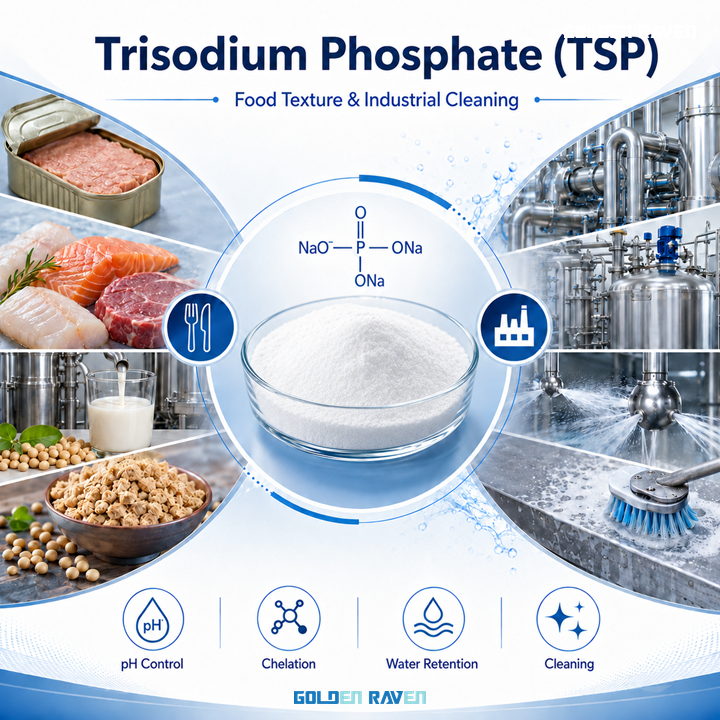
TSP is a typical strongly alkaline inorganic phosphate with multiple functions, including pH adjustment, metal ion chelation, protein structure modification, cleaning and degreasing, and water quality stabilization. It can be used as a texture-modifying additive in food processing, as well as in industrial cleaning, water treatment, and metal surface treatment.
In simple terms, the core value of TSP is not merely “addition”, but “regulation” - regulating the acid-base environment, protein structure, water system stability, and the cleaning efficiency of production systems.
1. What Is Trisodium Phosphate?
Trisodium Phosphate, with the chemical formula Na₃PO₄, is a trisodium salt of phosphoric acid produced through the neutralization reaction between phosphoric acid and sodium hydroxide. At room temperature, it is usually a white powder or crystalline material. A 1% aqueous solution typically has a pH of around 11.5–12.0, showing clear strong alkalinity.
TSP is commonly available in two forms:
Anhydrous Trisodium Phosphate (Na₃PO₄)It is relatively hygroscopic and dissolves quickly, making it suitable for applications that require faster reaction efficiency or stricter moisture control.
Trisodium Phosphate Dodecahydrate (Na₃PO₄·12H₂O)This form has a more stable crystalline structure and is commonly used in food processing, cleaning agents, and certain formulation systems. However, due to its crystal water content, its impact on the water balance of the formula should be considered during application.
In food systems, food-grade TSP belongs to the phosphate category of food additives, such as E339(iii) under the EU classification system. In industrial systems, it is more commonly used for cleaning, water treatment, descaling, and surface treatment.
It is important to emphasize that food-grade TSP and industrial-grade TSP must be strictly distinguished and must not be used interchangeably.
2. Key Functional Strengths of TSP
The wide application of TSP mainly comes from three key capabilities.
1. Strong Alkalinity: pH Adjustment
After dissolving in water, TSP can rapidly create an alkaline environment and help increase the pH of the system. In food processing, it can improve protein solubility and structural performance. In cleaning systems, it helps break down grease, protein residues, and stubborn deposits.
2. Chelating Ability: Capturing Calcium and Magnesium Ions
TSP can react with metal ions such as Ca²⁺ and Mg²⁺ through complexation or precipitation, thereby reducing the impact of hard water ions on system stability. This property is highly important in water treatment, dairy system stabilization, meat water retention, and equipment cleaning.
3. Thermal Stability: Suitable for Heat Processing
Under typical food heat-processing and industrial operating temperatures, TSP shows good stability and is not easily deactivated by heat. Therefore, it can be used in canning sterilization, baking, spray drying, plant protein processing, and high-temperature cleaning processes.
3. How Is TSP Produced?
The industrial production of TSP usually adopts the neutralization method. Phosphoric acid and sodium hydroxide are used as the main raw materials to generate trisodium phosphate through an acid-base neutralization reaction:
H₃PO₄ + 3NaOH → Na₃PO₄ + 3H₂O
The basic production process includes four main steps:
Raw Material PretreatmentFood-grade products require higher-purity raw materials, with strict control over heavy metals, impurities, and insoluble matter.
Neutralization ReactionThe feeding ratio, temperature, and pH are controlled in a stirred reaction system to ensure complete reaction and obtain a trisodium phosphate solution.
Concentration, Crystallization, and DryingTrisodium phosphate dodecahydrate can be obtained through concentration and cooling crystallization. Further dehydration and drying can produce anhydrous trisodium phosphate.
Refining and ClassificationFood-grade products focus more on purity, heavy metal limits, sensory indicators, and hygienic control. Industrial-grade products focus more on cleaning efficiency, chelating performance, and cost-effectiveness.
4. Applications in the Food Industry
The functions of food-grade TSP can be summarized as: pH adjustment, structure stabilization, water retention improvement, and precipitation control.
In meat products, poultry, seafood, and canned foods, TSP can improve protein structure by adjusting pH and chelating metal ions. This helps increase water-holding capacity, reduce cooking loss, and make the final product more tender and juicy. Typical applications include luncheon meat, ham, surimi products, imitation crab sticks, frozen prepared meat products, and ready-meal meat formulations.
In milk powder, non-dairy creamer, plant-based milk, and compound protein beverages, TSP can help adjust system pH and reduce precipitation, caking, or sandy texture caused by calcium and magnesium ions. This improves emulsion stability and shelf-life performance.
In certain bakery systems, TSP can be used as a pH regulator and formulation stabilizer. When used together with other phosphates or acidity regulators, it can help improve dough structure and product stability.
With the development of plant-based meat, plant-based milk, and high-protein foods, TSP is also receiving increasing attention in plant protein structure modification. It can help improve the dispersion, water retention, and processing stability of legume proteins, enabling plant-based foods to achieve a texture closer to real meat or dairy products.
5. Applications in Industrial Fields
Industrial-grade TSP is mainly used in system cleaning, hard water treatment, and surface treatment. It is a cost-effective basic functional chemical.
In water treatment, TSP can bind with calcium and magnesium ions in water, reducing scale formation. It is commonly used for water quality control in boilers, pipelines, circulating water systems, and industrial equipment.
In cleaning formulations, TSP combines strong alkalinity with chelating ability, helping remove grease, protein residues, mineral deposits, and stubborn stains. It is suitable for industrial cleaning, heavy-duty kitchen degreasing, and dairy equipment cleaning.
In metal surface treatment, TSP can be used for degreasing, cleaning, and surface activation before electroplating, coating, or metal processing. This helps improve the adhesion of subsequent coatings or plating layers.
In addition, TSP can also be used in ceramics, pigments, and inorganic material systems to adjust slurry pH and improve dispersion and stability.
6. How Is TSP Different from Other Phosphates?
Common phosphates used in food and industrial formulations include TSP, DSP, and STPP. Although they all belong to the phosphate family, their functional focuses are different.
TSP - Trisodium Phosphate
TSP has the strongest alkalinity and outstanding chelating ability. It is suitable for applications requiring strong pH adjustment, hard water softening, cleaning and descaling, and protein structure modification.
DSP - Disodium Phosphate
DSP has milder alkalinity and is more suitable for systems sensitive to pH, such as dairy products, bakery products, and beverages.
STPP - Sodium Tripolyphosphate
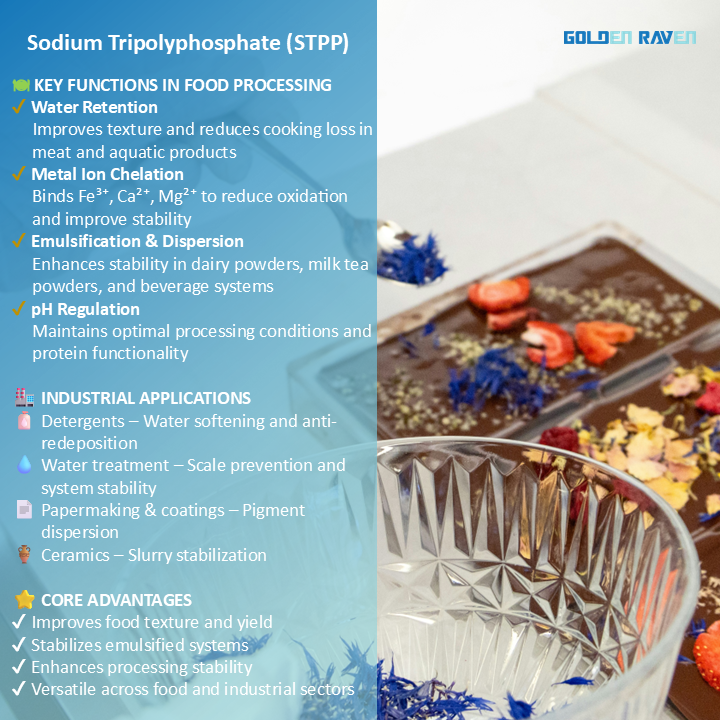
STPP offers good water retention, chelating, and emulsifying properties. It is commonly used in meat products, seafood products, frozen foods, and detergent systems.
In practical applications, TSP is often not used alone. It is commonly combined with STPP, DSP, citrate, or other ingredients to achieve a more balanced effect in pH control, water retention, emulsification, and system stability.
7. Safety and Regulatory Boundaries
The use of TSP in food applications must meet two basic requirements: food-grade quality and compliant dosage control.
Food-grade TSP must comply with the relevant food additive standards of each country or region, including clear requirements for purity, arsenic, lead, and other heavy metal indicators. At the same time, maximum permitted usage levels, residue requirements, and labeling rules for different food categories must follow local regulations.
Key points to note:
Food-grade TSP may be used in compliant food-processing applications, while industrial-grade TSP must not be used in food or animal feed. Since TSP is strongly alkaline, direct contact with skin, eyes, and mucous membranes should be avoided during handling and storage. On food labels, the product name, functional category, or additive number should be declared correctly according to local regulations. For halal, kosher, or specific export markets, HALAL, KOSHER, or other relevant certifications may also be required.
Therefore, the safety of TSP does not depend simply on whether it can be used, but on whether the correct grade, correct dosage, and correct regulatory pathway are followed.
8. Conclusion: The True Value of TSP
Trisodium Phosphate is not simply an alkaline salt. It is a functional raw material that integrates pH adjustment, metal ion chelation, protein structure modification, cleaning and degreasing, and thermal processing stability.
In the food industry, it helps meat products retain juiciness, supports the stability of dairy and plant-based beverages, and improves the structural performance of plant proteins.
In industrial applications, it helps keep equipment cleaner, water systems more stable, and metal surface treatment more efficient.
The value of TSP is often not found in the most visible part of the final product, but in the critical details of formulation, processing, and system operation.
Trisodium Phosphate (TSP): An Alkaline Regulator for Food Texture and Industrial Cleaning
Comments