
Understanding Compound Fertilizers: Nitrate, Sulfur, Chloride, Urea and Double-Sulfate Systems

Compound fertilizers can be classified by their main raw material systems, such as nitrate-sulfate-based, sulfur-based, chloride-based, urea-based and double-sulfate-based fertilizers. Each type has different nutrient release patterns, crop suitability and application requirements. Understanding these differences helps growers choose the right fertilizer for better yield, quality and soil management.
1. Nitrate-Sulfate-Based Compound Fertilizer
Nitrate-sulfate-based compound fertilizer usually uses ammonium nitrate as the nitrogen source and potassium sulfate as the potassium source. It contains both nitrate nitrogen and ammonium nitrogen, with low chloride content and no biuret.
This type is fast-acting and suitable for nitrate-loving crops such as vegetables, fruits, corn and tobacco, especially in dryland and calcareous alkaline soils. Nitrate nitrogen can be directly absorbed by crops, supporting rapid nutrient supply and improving phosphorus and potassium uptake.
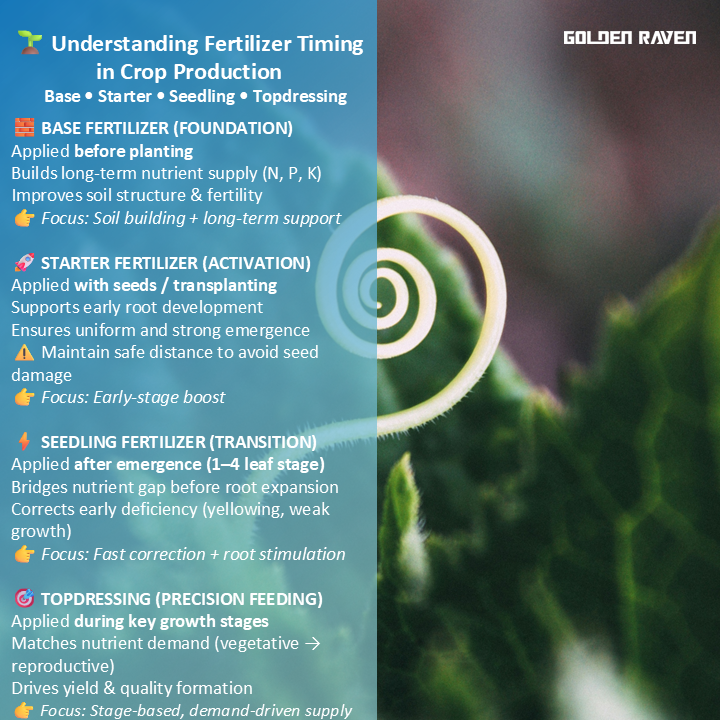
It can be used as basal fertilizer or topdressing. The fertilizer should be applied with soil covering and should not directly contact seeds or roots. It should not be mixed with alkaline fertilizers or pesticides.
2. Sulfur-Based Compound Fertilizer
Sulfur-based compound fertilizer uses potassium sulfate as the potassium source and naturally supplies sulfur. It is suitable for most soils and crops, especially sulfur-demanding crops such as onion, garlic, rapeseed and sugarcane.
It helps improve sulfur-deficient soils, supports beneficial microbial activity, enhances soil structure and improves crop quality. It is particularly useful for improving fruit color, sweetness, vegetable appearance and market value.
It can be used as basal fertilizer, topdressing, seed fertilizer or foliar fertilizer. For foliar application, spraying should avoid high temperature and strong sunlight. It should be used cautiously for aquatic vegetables.
3. Chloride-Based Compound Fertilizer
Chloride-based compound fertilizer uses potassium chloride as the potassium source. It is divided into single-chloride and double-chloride types. Single-chloride products use chloride-free nitrogen sources, while double-chloride products use ammonium chloride as the nitrogen source.
This type is suitable for chlorine-tolerant crops such as rice, wheat, corn, hemp crops and sugar beet. It is cost-effective and provides relatively fast nutrient availability. For hemp crops, chloride can help improve fiber development and toughness.
It is not suitable for chlorine-sensitive crops or saline-alkaline soils, and should not be used as seed fertilizer. In acidic or neutral soils, it is better applied together with organic fertilizer to reduce the negative effects of chloride ions.
4. Urea-Based Compound Fertilizer
Urea-based compound fertilizer uses urea as the nitrogen source and is commonly produced with monoammonium phosphate, diammonium phosphate, potassium sulfate or potassium chloride. Nitrogen mainly exists as amide nitrogen.
Its fertilizer effect is relatively long-lasting because amide nitrogen must first be converted into ammonium nitrogen by soil microorganisms before being largely absorbed by crops. This makes it suitable for supporting crop nitrogen demand over a longer growth period.
It can be used as basal fertilizer or topdressing. Basal application is usually recommended 7-10 days before sowing or transplanting. Topdressing should be covered with soil to reduce ammonia volatilization. It should not be mixed with alkaline fertilizers such as plant ash.
5. Double-Sulfate-Based Compound Fertilizer
Double-sulfate-based compound fertilizer uses ammonium sulfate as the nitrogen source and potassium sulfate as the potassium source, providing two sulfur sources and complete NPK nutrition.
It is especially suitable for high-value fruits, vegetables, flowers and sulfur-deficient soils. It offers stable nutrient release, improves soil structure, promotes root development and enhances crop resistance to drought, waterlogging, pests and diseases.
It can be used as basal fertilizer, topdressing or seed fertilizer. When used as seed fertilizer, it must be kept separated from seeds to avoid seed burn. The application rate should be adjusted according to soil fertility and crop growth conditions.
Summary
Different compound fertilizers are suitable for different crops, soils and application methods. Fertilizer selection should consider soil pH, salinity, sulfur deficiency, crop chloride tolerance, nutrient demand and cost.
Choosing the right fertilizer based on local conditions can improve crop yield and quality, maintain soil health and reduce unnecessary input costs.

Understanding Compound Fertilizers: Nitrate, Sulfur, Chloride, Urea and Double-Sulfate Systems


Comments