
What Is Produced in Much Larger Amounts Alongside Phosphoric Acid? How to Turn Phosphogypsum Waste into Value?

Phosphoric acid is a core basic raw material in the phosphate chemical industry. Industrial phosphoric acid production is mainly divided into two routes: thermal-process phosphoric acid and wet-process phosphoric acid. Among them, wet-process phosphoric acid accounts for more than 90% of the global market due to its large production capacity, controllable cost structure, and strong suitability for mass fertilizer production. It is mainly produced by decomposing phosphate rock with sulfuric acid and is widely used in the manufacture of various high-efficiency phosphate fertilizers.
However, the wet-process phosphoric acid production process generates a large volume of industrial solid waste: phosphogypsum. This has become one of the key bottlenecks restricting the green transformation of the phosphate chemical industry.
Core reaction equation of wet-process phosphoric acid:
Ca₅(PO₄)₃F + 5H₂SO₄ + 10H₂O → 5CaSO₄·2H₂O + 3H₃PO₄ + HF↑
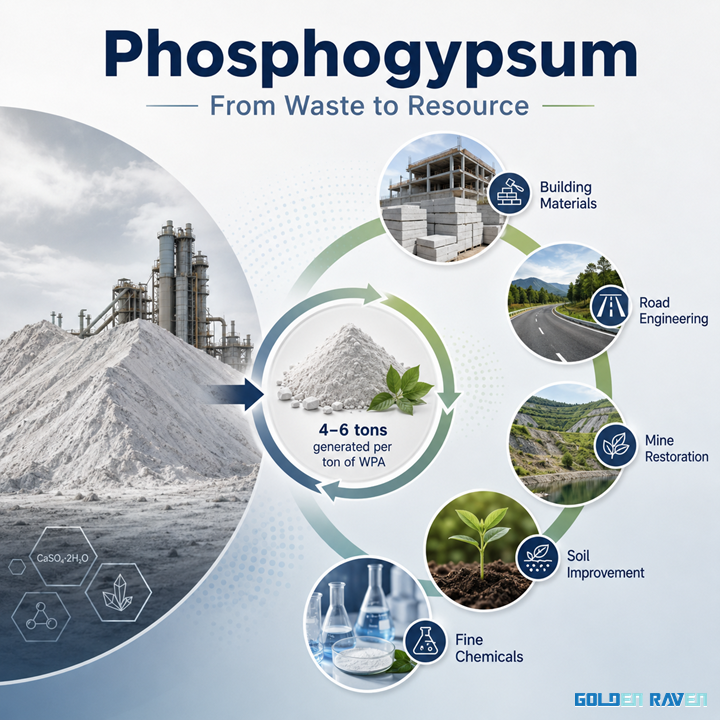
According to authoritative industry data, every 1 ton of wet-process phosphoric acid produced generates approximately 4–6 tons of phosphogypsum. The output volume is enormous, creating significant pressure from long-term stockpiling. According to 2024 industry reports from China’s Ministry of Ecology and Environment and the China Phosphate & Compound Fertilizer Industry Association, China produces approximately 86 million tons of phosphogypsum annually, while the national accumulated stockpile has exceeded 870 million tons. China has long ranked first globally in phosphogypsum stockpiling, and the traditional landfill and open-air stacking model is becoming increasingly unsustainable.
I. Basic Characteristics and Physicochemical Indicators of Phosphogypsum
Phosphogypsum, often abbreviated as PG, is an acidic industrial by-product gypsum generated during wet-process phosphoric acid production. Its main component is calcium sulfate dihydrate, CaSO₄·2H₂O.
Its appearance is usually gray-white, gray-yellow, or light-green powder. The bulk density is generally 0.733-0.88 g/cm³, with an adhered water content of 10%–30%. The pH value of a 1% aqueous solution is only 1.9-5.3, indicating strong acidity. Its crystal morphology is mainly needle-like or plate-like, with particle sizes concentrated in the range of 40-200 μm and a relatively uniform particle size distribution.
Phosphogypsum has a complex chemical composition. It contains residual trace amounts of organic phosphorus, inorganic phosphorus, fluorides, and impurities such as potassium, sodium, aluminum, and magnesium. It may also contain very small amounts of heavy metals such as arsenic, cadmium, and mercury, as well as radioactive elements. Most of these are insoluble inert solids, and their hazards are generally negligible under controlled conditions.
However, residual soluble phosphorus, soluble fluorine, and free organic acids are the main factors causing environmental pollution and restricting the resource utilization of phosphogypsum. Therefore, before industrial application, phosphogypsum must undergo modification, impurity removal, and pretreatment.
II. Main Types of Impurities and Their Harm Mechanisms
The impurities in phosphogypsum can be broadly divided into soluble impurities and insoluble impurities. Different impurities have significantly different effects on product performance and the ecological environment.
1. Insoluble Impurities
Insoluble impurities include undecomposed apatite, quartz, sparingly soluble phosphates, co-crystallized phosphorus, and inert fluorides. These substances are chemically stable and have very limited impact on subsequent processing performance.
2. Soluble Impurities: The Core Source of Risk
Soluble impurities mainly include water-soluble phosphorus, active fluorine, and residual organic acids. These are the key factors that restrict the utilization of phosphogypsum and create environmental risks.
Phosphorus in phosphogypsum exists in three main forms: soluble phosphorus, co-crystallized phosphorus, and insoluble phosphorus. Soluble phosphorus, mainly in the forms of H₃PO₄ and H₂PO₄⁻, is the most reactive. It can significantly reduce the strength of building materials and prolong setting time. Co-crystallized phosphorus can produce a retarding effect, increase the water demand of building materials, and weaken structural stability. Insoluble phosphorus is inert and generally has no significant negative impact.
Fluorine exists as soluble fluorine and insoluble fluorine. Soluble fluorine can damage the structure of hydration products, resulting in loose crystals and reduced product strength. Insoluble fluorine is stable and does not pose obvious harm.
In addition, trace organic matter attached to the surface of phosphogypsum particles can increase the water demand of building materials, weaken crystal bonding, and lead to loose finished products, abnormal color differences, and lower strength.
III. The Stockpiling Challenge: Dual Pressure from Land Occupation and Environmental Protection
China’s phosphate chemical industry is mainly concentrated in Hubei, Yunnan, Sichuan, Guizhou, and other provinces along the Yangtze River basin. As a result, phosphogypsum output is highly concentrated, creating severe regional stockpiling pressure.
Long-term open-air storage not only occupies large areas of land, but also creates safety risks such as overflow or collapse of storage yards. At the same time, rainfall leaching can carry water-soluble phosphorus, fluorine, and other pollutants into soil and groundwater, leading to water eutrophication, soil acidification, salinization, and other ecological problems.
High maintenance costs for phosphogypsum storage yards, combined with increasingly strict environmental control standards, have become a major bottleneck restricting capacity release and green upgrading for phosphate chemical enterprises.
IV. Mainstream Impurity Removal and Pretreatment Technologies
At present, mature phosphogypsum modification and impurity removal technologies can be divided into three categories: physical methods, thermal treatment methods, and chemical methods. These technologies are suitable for different impurity levels and application scenarios, each with its own advantages and limitations.
1. Physical Methods
Physical methods include washing, flotation, ball milling, screening, and aging. They are the most widely used pretreatment methods.
Washing can efficiently remove soluble phosphorus, fluorine, and surface organic matter, and is suitable for raw materials with fluctuating impurity contents. However, the washing wastewater requires special treatment, otherwise it may cause secondary pollution.
2. Thermal Treatment Methods
Thermal treatment converts active impurities into more stable components through high-temperature calcination, including the decomposition or transformation of co-crystallized phosphorus and other impurities. This process is relatively simple and does not generate secondary pollution.
However, high-temperature treatment changes the gypsum crystal structure. Calcium sulfate dihydrate is converted into hemihydrate or anhydrous gypsum, which changes the nature of the raw material and limits its application scenarios.
3. Chemical Methods
Chemical treatment is mainly based on alkaline neutralization using quicklime, CaO. Through acid-base reactions, soluble phosphorus and fluorine impurities are solidified, while the pH of the material is adjusted to a neutral level.
This process significantly improves the stability and usability of phosphogypsum and is currently one of the preferred core technologies for industrial-scale pretreatment.
V. Comparison of Resource Utilization in China and Overseas Markets
The global resource utilization of phosphogypsum shows clear regional differences.
In the United States, natural gypsum resources are abundant, and around 98% of phosphogypsum is still treated by stockpiling. The resource utilization rate remains relatively low.
Japan and Germany, by contrast, lack natural gypsum resources and have developed more advanced phosphogypsum utilization technologies. In Japan, the utilization rate is close to 100%. Approximately 60% is used in gypsum building materials, 30% is used as a cement retarder, and the remainder is applied in food and medical fields. Germany’s utilization rate has reached around 95%, with the main application being auxiliary materials for the cement industry.
In China, driven by policy support and technological upgrading, the level of resource utilization has continued to improve. In 2024, China’s comprehensive utilization rate of phosphogypsum reached 55.6%, a significant increase compared with ten years ago. However, there is still a gap compared with the industry target of 65% by 2026.
At present, China’s phosphogypsum applications are mainly concentrated in five major areas: building materials, transportation, agriculture, mine restoration, and fine chemicals. The industrial utilization system is becoming increasingly mature.
VI. Diversified Resource Utilization Scenarios
1. Building Materials: The Most Mature and Largest-Volume Application
After harmless modification, phosphogypsum can become a high-quality air-hardening cementitious material. It can be used to produce gypsum board, gypsum blocks, plastering mortar, self-leveling gypsum, and other indoor building materials.
These products offer advantages such as thermal insulation, sound insulation, fire resistance, light weight, and environmental friendliness. Phosphogypsum can also be used as a cement retarder to regulate cement setting time and improve construction performance. At present, building materials represent the largest-volume application channel for phosphogypsum consumption.
To overcome the poor water resistance of traditional gypsum materials, the industry has developed composite-modified hydraulic cementitious materials, effectively expanding the use of phosphogypsum into outdoor application scenarios.
2. Road Engineering
After washing, neutralization, solidification, and modification, phosphogypsum can replace traditional aggregates in the preparation of roadbed materials.
Compared with conventional roadbed mixtures, phosphogypsum-based roadbed materials can offer better compactness, compressive strength, and alkali resistance, helping ensure the stability of road base layers. With lower raw material costs and a large capacity for solid waste consumption, this provides a high-quality green cost-reduction solution for infrastructure construction.
3. Mine Backfilling and Ecological Restoration
Modified hemihydrate phosphogypsum can be used as a cemented backfill material. Materials with qualified strength can be used for underground goaf backfilling, while lower-strength materials can be used for ecological restoration and land reclamation in open-pit mines.
This technology has already been applied at scale in dozens of mines in China, achieving integrated benefits in solid waste consumption, geological disaster prevention, and ecological restoration.
4. Agricultural Soil Improvement: The Fastest-Growing Application
Phosphogypsum is rich in calcium, sulfur, phosphorus, and other essential secondary and trace nutrients required by crops. Its acidic characteristics make it suitable for targeted improvement of saline-alkali soils and secondary salinized soils. It can help regulate soil pH balance and loosen soil structure.
At the same time, phosphogypsum can reduce aluminum toxicity accumulation in soil and alleviate soil compaction and acidification caused by long-term fertilization and excessive herbicide use. By improving soil fertility, it has become a valuable green material for saline-alkali land improvement.
5. High-Value Utilization in Fine Chemicals
Through purification and modification technologies, phosphogypsum can be used to produce high-value chemical products such as calcium sulfate whiskers, ammonium sulfate, and potassium sulfate, fully unlocking the value of its sulfur and calcium resources.
Among them, calcium sulfate whiskers feature high strength, high temperature resistance, insulation properties, and corrosion resistance. They can be used as reinforcing fillers, filtration materials, fire-resistant and thermal insulation materials, and are widely applied in new materials, high-end building materials, cable coating, and other fields. This represents an important pathway for the high-value utilization of industrial solid waste.
VII. Industry Summary and Future Outlook
The resource utilization of phosphogypsum is a core pathway for the phosphate chemical industry to reduce carbon emissions, control pollution, solve the long-standing problem of solid waste stockpiling, and build a circular economy.
China has already formed a diversified utilization structure in which building material consumption serves as the main pathway, agricultural restoration acts as a complementary channel, and fine chemical processing creates additional value.
With the continuous iteration of pretreatment and modification technologies, the development of high-value deep-processing processes, and the support of carbon reduction and solid waste resource utilization policies, phosphogypsum is expected to gradually move beyond the label of “industrial waste residue.”
In the future, it will become a green recycled resource with ecological, social, and economic value, offering broad development potential for industrial-scale, large-volume, and high-value utilization.
What Is Produced in Much Larger Amounts Alongside Phosphoric Acid? How to Turn Phosphogypsum Waste into Value?

Comments