
From Potassium Chloride to Potassium Sulfate
- Yang Wu
- 7 minutes ago
- 7 min read

Production Routes, Product Grades, and Fertilizer Selection
Potassium is one of the three primary macronutrients required by plants. It plays an essential role in carbohydrate synthesis and transport, water regulation, enzyme activation, stress tolerance, crop quality, and yield formation.
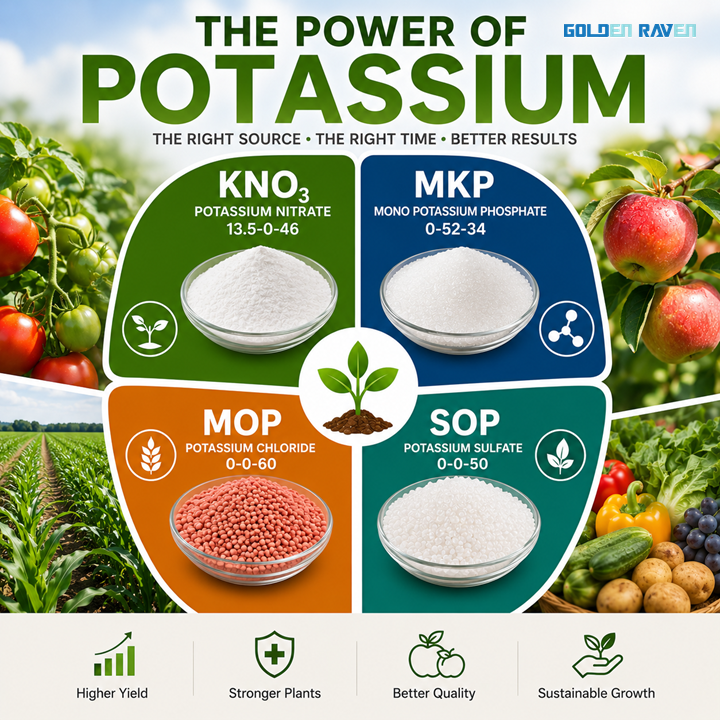
Potassium chloride, commonly known as muriate of potash or MOP, and potassium sulfate, commonly known as sulfate of potash or SOP, are two of the most widely used potassium fertilizers. Although both supply plant-available potassium, they differ significantly in chemical composition, production route, chloride content, cost, and agronomic suitability.
This article explains the relationship between MOP and SOP, introduces the principal production routes for potassium sulfate, compares naturally derived and conversion-based products, and clarifies the practical meaning of the commonly traded 50% and 52% K₂O grades.
1. Potassium Chloride and Potassium Sulfate: The Same Potassium, Different Anions
The fundamental similarity between potassium chloride and potassium sulfate is that both release potassium ions, K⁺, after dissolving in soil water. These potassium ions can then be absorbed by plant roots.
Their agronomic differences are mainly associated with the accompanying anions:
Potassium chloride supplies chloride, Cl⁻.
Potassium sulfate supplies sulfate, SO₄²⁻, together with sulfur.
Potassium chloride is generally the more economical potassium source and is widely used on chloride-tolerant crops. However, excessive chloride may be undesirable for chloride-sensitive crops, saline soils, protected cultivation, or production systems in which crop quality is particularly important.
Potassium sulfate contains little chloride and also supplies sulfur in the sulfate form. It is therefore widely selected for crops and production conditions that are sensitive to chloride or high salt concentrations.
From an industrial perspective, potassium chloride is also an important feedstock for SOP production. Potassium sulfate may be obtained either by converting potassium chloride with sulfuric acid or other sulfate salts, or by recovering potassium sulfate from naturally occurring sulfate minerals and brines.
2. Principal Production Routes for Potassium Sulfate
Commercial potassium sulfate can be broadly divided into two categories:
Conversion-based SOP, produced by chemically converting potassium chloride.
Naturally derived SOP, recovered from sulfate-bearing minerals or brines.
These categories describe the origin and production route, but they do not by themselves determine the final purity, solubility, chloride level, or application quality of the product.
2.1 The Mannheim Process
The Mannheim process is one of the best-established industrial methods for converting potassium chloride into potassium sulfate.
Potassium chloride is reacted with concentrated sulfuric acid in a heated Mannheim furnace. The process takes place through two principal reaction stages:
KCl + H₂SO₄ → KHSO₄ + HCl↑
KCl + KHSO₄ → K₂SO₄ + HCl↑
The overall reaction is:
2KCl + H₂SO₄ → K₂SO₄ + 2HCl↑
Hydrogen chloride generated during the reaction is normally absorbed in water and recovered as hydrochloric acid, creating a commercially useful co-product. The process can produce SOP with controlled composition and relatively consistent quality, provided that raw-material quality, reaction conditions, cooling, neutralization, crushing, screening, and dust control are properly managed.
The principal advantages of the Mannheim process include:
Broad availability of potassium chloride feedstock
Stable and controllable production
Potential to produce high-analysis SOP
Commercial recovery of hydrochloric acid
Its main limitations include:
Relatively high thermal-energy consumption
Corrosive operating conditions
Strict requirements for furnace control and refractory materials
The need for efficient hydrogen chloride absorption and emission-control systems
2.2 Double-Decomposition and Crystallization Processes
Potassium sulfate may also be produced through ion-exchange or double-decomposition reactions between potassium chloride and sulfate-bearing salts, such as sodium sulfate or magnesium sulfate-containing materials.
Depending on the raw materials and process design, intermediate salts such as glaserite, schoenite, or related mixed potassium sulfates may first be formed. These intermediates are subsequently decomposed, dissolved, separated, and crystallized to obtain the final SOP product.
These processes generally operate at lower temperatures than the Mannheim process. Their technical and economic performance depends heavily on:
The composition and cost of the sulfate feedstock
Phase-equilibrium and crystallization control
Recovery and recycling of potassium
Separation of sodium, magnesium, chloride, and other salts
Management or commercialization of the co-products
Double-decomposition routes can be energy-efficient, but their product quality is determined by the overall purification and crystallization system rather than by the reaction route alone. Potassium sulfate manufacturing routes involving sodium sulfate, magnesium sulfate minerals, langbeinite, and schoenite are all commercially recognized.
2.3 Recovery from Natural Minerals and Brines
Naturally derived SOP is produced from sulfate-rich mineral deposits, mixed potash salts, or salt-lake brines.
Depending on the deposit, production may involve:
Mining or brine extraction
Crushing and mineral beneficiation
Flotation or selective separation
Dissolution and impurity removal
Evaporation or cooling crystallization
Drying, screening, and granulation
Natural feedstocks may contain potassium together with magnesium, sodium, calcium, chloride, and other sulfate salts. Some products retain useful magnesium or other secondary nutrients, while others are extensively refined to produce high-purity potassium sulfate.
The main advantage of this route is that it can avoid the direct high-temperature reaction between potassium chloride and sulfuric acid. However, the feasibility of the process is highly dependent on the location, mineralogy, concentration, and processing characteristics of the deposit.
Naturally derived SOP is therefore geographically concentrated and less flexible in plant location than conversion-based production. Nevertheless, natural origin should not be interpreted as automatically meaning lower purity or poorer performance; modern beneficiation and crystallization systems can produce highly refined products.
3. What Do 50% and 52% SOP Actually Mean?
Potassium fertilizer grades are normally expressed as the equivalent percentage of potassium oxide, K₂O, rather than as elemental potassium.
Chemically pure potassium sulfate has a theoretical nutrient analysis of approximately:
54.05% K₂O
45.95% SO₃, equivalent to approximately 18.4% sulfur
Commercial fertilizer-grade SOP typically contains approximately 48%–52% K₂O, depending on product purity, moisture, chloride, residual salts, insoluble matter, and manufacturing specifications.
Assuming that all declared potassium originates from potassium sulfate:
A 50% K₂O product corresponds theoretically to about 92.5% potassium sulfate.
A 52% K₂O product corresponds theoretically to about 96.2% potassium sulfate.
These figures are approximate because commercial products may contain other potassium-bearing compounds, moisture, processing aids, or residual salts.
Most importantly, 50% and 52% K₂O are product-analysis grades, not production-process labels.
A 52% product is not necessarily produced by the Mannheim process, and a 50% product is not necessarily produced by double decomposition. Both natural and conversion-based processes may produce different nutrient grades depending on feedstock quality, purification intensity, recovery targets, granulation requirements, and commercial product positioning.
Similarly, a higher K₂O analysis does not automatically guarantee better dissolution or suitability for fertigation. A 50% SOP product may be completely water-soluble, while a poorly refined 52% material may still contain excessive insoluble matter or undesirable particle characteristics. Commercial 50% SOP grades are available with fully water-soluble potassium, while specialized 52%-52.5% grades are marketed for rapid dissolution, fertigation, and foliar application.
Buyers should therefore evaluate the complete specification, including:
Water-soluble K₂O
Total and water-soluble sulfur
Chloride content
Moisture
Water-insoluble matter
Sodium and magnesium
Free acidity
pH
Particle-size distribution
Dissolution rate
Appearance and anti-caking performance
4. Naturally Derived and Conversion-Based SOP: A Practical Comparison
Criterion | Naturally Derived SOP | Conversion-Based SOP |
Feedstock | Sulfate-bearing minerals or brines | Primarily potassium chloride plus sulfuric acid or sulfate salts |
Geographical flexibility | Restricted by mineral deposits or brine resources | Plants can be located closer to raw materials, markets, ports, or hydrochloric-acid users |
Process characteristics | Mining, beneficiation, dissolution, separation, and crystallization | Chemical conversion followed by cooling, purification, crystallization, or granulation |
Co-nutrients | May naturally contain magnesium or other secondary nutrients | Composition can be designed and controlled more independently |
Product consistency | Depends on deposit uniformity and refining technology | Generally controllable through standardized feedstock and process management |
Purity potential | Can range from multi-nutrient natural products to highly purified SOP | Can range from standard agricultural grades to high-purity soluble products |
Environmental priorities | Mining impact, brine balance, tailings, water use, and land rehabilitation | Energy consumption, corrosion control, gaseous HCl recovery, and salt co-product management |
Typical product forms | Powder, crystals, granules, or potassium-magnesium sulfate products | Powder, crystals, compacted or chemically granulated SOP |
Neither route is universally superior. Product performance depends on the final specification and manufacturing control rather than solely on whether the raw material is natural or chemically converted.
5. Selecting the Appropriate Potassium Fertilizer
Fertilizer selection should balance crop sensitivity, soil conditions, application method, nutrient requirements, product quality, and cost.
5.1 Crop Sensitivity to Chloride
SOP is generally preferred for chloride-sensitive or high-value crops, including tobacco, grapes, many fruits, vegetables, and certain protected-cultivation crops.
MOP remains an economical and effective potassium source for chloride-tolerant crops, provided that soil salinity, irrigation-water quality, chloride accumulation, and application rate are properly managed.
5.2 Soil Application
For basal application, topdressing, and conventional field spreading, both 50% and 52% SOP may be suitable. Granule strength, particle-size uniformity, spreading quality, chloride content, and cost are often more important than a two-percentage-point difference in K₂O.
Naturally derived SOP, standard 50% SOP, and granular conversion-based SOP may all perform effectively when selected according to soil-test results and crop nutrient requirements.
5.3 Fertigation and Foliar Application
Products used in drip irrigation, greenhouse systems, stock solutions, or foliar sprays should be selected according to:
Complete water solubility
Low water-insoluble content
Low chloride and sodium
Rapid dissolution
Fine and uniform crystal structure
Compatibility with other fertilizers
A specialized soluble SOP grade is usually more appropriate than a conventional granular product. However, this suitability must be confirmed through the product’s technical data sheet rather than inferred from the 50% or 52% K₂O designation alone.
Calcium-containing fertilizers should generally not be mixed in the same concentrated stock solution with sulfate fertilizers because calcium sulfate precipitation may occur. Small-scale compatibility testing is recommended before preparing concentrated fertilizer mixtures.
5.4 Economic Considerations
Higher nutrient concentration can reduce the amount of material required to supply a given quantity of potassium, but the commercial value of SOP also depends on:
Freight and handling cost
Product loss and dust generation
Application efficiency
Chloride limits
Solubility
Crop value
Sulfur requirement
The availability and price of alternative potassium sources
For non-critical growth stages or broadacre crops, a well-manufactured 50% SOP product may provide a better economic balance. For precision fertigation, foliar feeding, sensitive crops, or high-value production, a refined soluble grade may justify a higher price.

From Potassium Chloride to Potassium Sulfate


Comments