
Guide to Identifying and Correcting Nitrogen, Phosphorus and Potassium Deficiencies in Crops

Nitrogen, phosphorus and potassium are the three essential macronutrients for crop growth. They directly affect plant vigor, stress resistance, yield and quality. Insufficient fertilization, unbalanced nutrient ratios, poor soil conditions and abnormal weather can all lead to nutrient deficiency disorders. At the same time, blind or excessive fertilization may also cause nutritional imbalance, weak growth, yield loss and quality decline.
Accurate identification of deficiency symptoms, prevention of over-fertilization risks and targeted scientific correction are key to achieving high and stable crop yields.
This guide summarizes the core functions of nitrogen, phosphorus and potassium, typical deficiency symptoms, risks of excessive application, main causes of deficiency and practical correction methods, providing growers with clear and field-applicable guidance for crop diagnosis and fertilization management.
1. Core Functions of Nitrogen, Phosphorus and Potassium
1. Nitrogen: The Growth Engine of Crops
Nitrogen is a key component of chlorophyll, proteins and biological enzymes. It plays a leading role in photosynthesis, stem and leaf growth, and nutrient accumulation. Adequate nitrogen supply promotes lush foliage, strong vegetative growth and higher basic yield potential.
2. Phosphorus: The Energy Messenger of Crop Metabolism
Phosphorus is involved in photosynthesis, respiration and nutrient metabolism. Its core functions include promoting root development, flower bud differentiation, flowering and fruit setting. It also significantly improves crop resistance to drought, cold and other stress conditions.
3. Potassium: The Quality and Health Guardian of Crops
Potassium helps regulate water balance within plants, strengthens resistance to disease, lodging and extreme weather, and promotes the synthesis and transport of sugars and organic compounds. It plays an important role in improving fruit taste, crop quality and market value.
2. Typical Symptoms of NPK Deficiency and Over-Fertilization
A. Nitrogen Deficiency and Excess Nitrogen Application
Typical symptoms of nitrogen deficiency
Weak growth and yellowing leaves: Plants grow slowly and remain small. Due to insufficient chlorophyll synthesis, older lower leaves turn yellow first, then the symptoms gradually move upward. In severe cases, leaves may dry out and fall off.
Poor root development: Roots are short with fewer fibrous roots, greatly reducing water and nutrient absorption capacity. Plants become weak and lack vigor.
Poor flower and fruit development: Flowering is delayed, fruit setting is reduced, fruits become smaller, nutrient accumulation is insufficient, and overall quality declines.
Consequences of excessive nitrogen application
Excess nitrogen can cause excessive vegetative growth, dense foliage, dark green leaves and weak plant structure. Plants may appear vigorous but are more prone to premature aging.
It can also delay root development, disrupt the balance between above-ground and below-ground growth, and reduce resistance to pests and diseases.
In addition, excessive nitrogen may lead to weak stems with poor toughness, greatly reducing lodging resistance. Crops are more likely to lodge under wind and rain.
B. Phosphorus Deficiency and Excess Phosphorus Application
Typical symptoms of phosphorus deficiency
Stunted plants and poor seedling growth: Cell division is restricted, crop growth slows or stops, branching and tillering are reduced, and plants may become stunted.
Abnormal leaf color: Older leaves may become dark green or purplish-red. Leaves are often small and narrow, with dry edges or abnormal development.
Poor flowering and fruiting: Flower bud differentiation is delayed, flowering is reduced, flower and fruit drop increase, grains become shriveled and poorly filled, and yield may decline sharply.
Consequences of excessive phosphorus application
Excess phosphorus may force crops to enter reproductive growth too early, causing premature aging and early maturity, which can result in smaller grains and lower yield.
Too much phosphorus in the soil can also combine with zinc to form insoluble compounds, inducing zinc deficiency.
It may also immobilize available silicon in the soil, suppressing the normal growth of gramineous crops and reducing stress resistance.
C. Potassium Deficiency and Excess Potassium Application
Typical symptoms of potassium deficiency
Yellowing and scorching of leaf edges: Symptoms usually appear first on the tips and edges of older lower leaves. The leaf margins turn yellow and scorched. In severe cases, the entire leaf may dry out and die.
Soft stems and poor lodging resistance: Stems lack strength and toughness. Plants grow weakly and show reduced resistance to lodging and disease.
Poor fruit quality: Fruit setting is reduced, fruit enlargement is slow, maturity is delayed, sugar accumulation is insufficient, taste is poor and marketability declines.
Consequences of excessive potassium application
Excessive potassium may reduce crop cold resistance, making plants less able to withstand low temperatures, frost and other extreme weather conditions.
It can also inhibit the absorption of magnesium and calcium, easily inducing physiological disorders such as internal browning, hollow heart, leaf chlorosis and quality problems in fruits and vegetables.
3. Main Causes of Nitrogen, Phosphorus and Potassium Deficiency
1. Poor soil conditions
Poor, low-fertility soils with low organic matter content are more likely to suffer from nitrogen and potassium deficiency, especially sandy soils where nutrients are easily lost.
Strongly acidic or alkaline soils can significantly reduce the availability of nutrients such as phosphorus, making them difficult for crops to absorb.
Long-term lack of fertilization and continuous nutrient depletion can also lead to persistent nutrient deficiencies.
2. Unscientific fertilization practices
Insufficient fertilizer application cannot meet crop growth demand. Long-term use of a single fertilizer can easily cause imbalance among nitrogen, phosphorus and potassium.
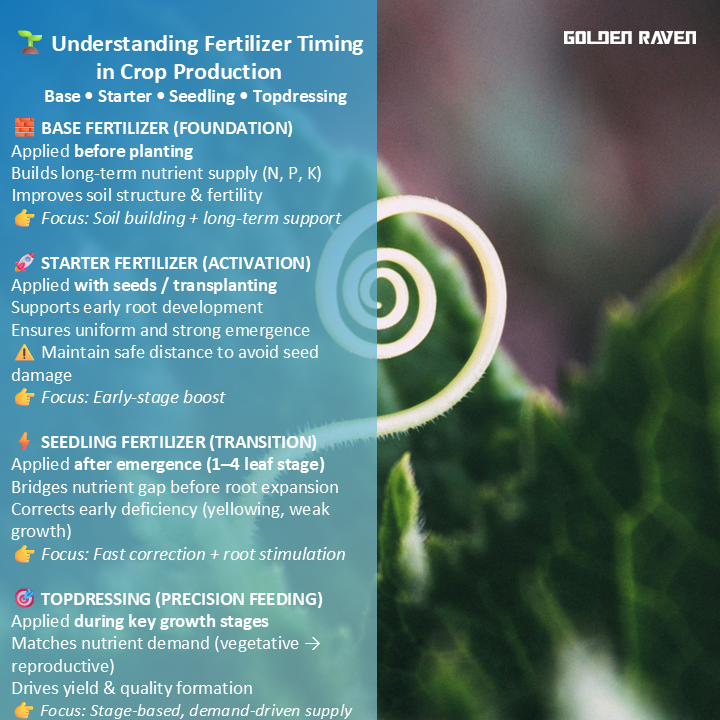
Delayed fertilization or improper application methods can also lead to nutrient deficiency and unbalanced crop growth.
3. Climate and environmental impacts
Continuous rainfall can cause nitrogen leaching and nutrient loss.
Long-term drought prevents soil nutrients from dissolving properly and limits root absorption.
Extreme high or low temperatures can reduce root activity and nutrient uptake efficiency, leading to physiological nutrient deficiencies.
4. Practical and Scientific Correction Methods
1. Correcting nitrogen deficiency
Fast-acting nitrogen fertilizers such as urea and ammonium bicarbonate are recommended. Application rates should be adjusted according to crop type and growth stage.
During vigorous growth, urea can be applied at 10–15 kg per mu, or ammonium bicarbonate at 25–30 kg per mu. Band application or hole application near the root zone is recommended to improve absorption efficiency.
For rapid symptom relief, foliar spraying can be used together with soil application. Spray a 0.5%–1% urea solution once every 7-10 days for 2-3 consecutive applications to quickly supplement nitrogen and restore crop growth.
2. Correcting phosphorus deficiency
For acidic soils, calcium magnesium phosphate fertilizer is preferred. For neutral or alkaline soils, superphosphate is more suitable.
Generally, apply 20–30 kg of superphosphate per mu, or 30-40 kg of calcium magnesium phosphate fertilizer per mu. Mixing with organic fertilizer is recommended to activate soil phosphorus and improve fertilizer efficiency.
For foliar phosphorus supplementation, spray a 2%-3% superphosphate extract once every 7-10 days for 2-3 consecutive applications. This can help improve stunted growth, poor seedling development and poor flower or fruit development caused by phosphorus deficiency.
3. Correcting potassium deficiency
For common crops, apply 5-10 kg per mu of potassium chloride or potassium sulfate. For chlorine-sensitive crops such as tobacco, potato and grape, potassium sulfate should be used to avoid chlorine injury.
Application methods may include band application, hole application, or broadcasting followed by soil incorporation.
For rapid potassium supplementation and improved stress resistance, foliar spray with 0.2%–0.3% mono potassium phosphate solution once every 7-10 days for 2-3 consecutive applications. This can effectively improve leaf-edge scorching, poor fruit quality and other potassium deficiency symptoms.

Guide to Identifying and Correcting Nitrogen, Phosphorus and Potassium Deficiencies in Crops


Comments