
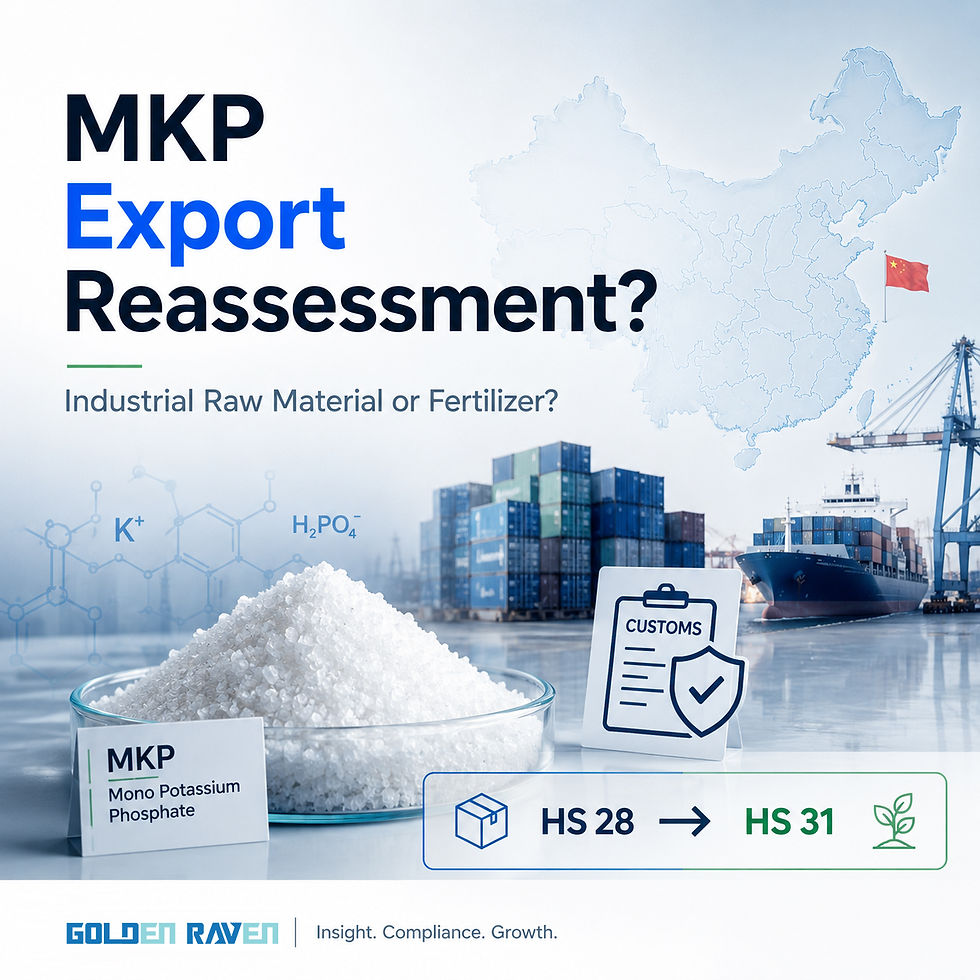
Is MKP’s Export Positioning Entering a Phase of Reassessment?

Recent Customs Visits Have Raised Industry Attention
Recently, Chinese Customs has begun conducting field visits and investigations at selected MKP production enterprises. These visits reportedly cover major MKP production regions, including Hubei, Sichuan, and Yunnan.
This has attracted attention within the industry and raised an important question: under the current export control environment for nitrogen, phosphorus, and potassium-related products, why is MKP — a product with high phosphorus and potassium content — still being exported in large volumes under the positioning of an “industrial raw material”?
MKP’s Dual Identity: Industrial Phosphate or Fertilizer Raw Material?
From a product attribute perspective, MKP has always occupied a rather unique position.
On the one hand, it is a typical phosphate product that can be used in water treatment, food processing, industrial formulations, and fine chemical applications. On the other hand, it is also one of the most important phosphorus-potassium fertilizer raw materials in the global water-soluble fertilizer system, widely applied in fertigation, foliar spraying, high-end NPK formulations, and chloride-free crop nutrition programs.
Because of this dual nature, MKP has long existed in a grey area between industrial chemicals and fertilizer products in actual export declarations.
Possible HS Code Repositioning: From Chapter 28 to Chapter 31?
The core concern now is whether the customs classification of MKP may gradually shift from Chapter 28, which covers inorganic chemical products, toward Chapter 31, which covers fertilizers.
At present, MKP is commonly classified under the category of potassium phosphates. However, from the perspective of actual use, nutrient composition, and export destination, it may also be interpreted as a mineral or chemical fertilizer containing both phosphorus and potassium nutrients.
If the authorities move toward reassessing MKP based on its practical application and nutrient attributes, the regulatory logic surrounding this product could change significantly.
Potential Impact 1: Longer Export Procedures
Once MKP is more clearly incorporated into fertilizer-related export management, the export process may become significantly longer.
If the relevant HS code is added to the statutory inspection list for export goods, its regulatory condition may shift toward “B”, meaning that inspection, quarantine, or electronic account procedures may be required before export.
In that case, MKP would no longer be shipped with the same flexibility as an ordinary industrial chemical. Order execution cycles, booking schedules, customs preparation, and pre-shipment inventory planning could all become longer and more complex.
Potential Impact 2: More Concentrated Export Qualifications
Another possible impact is the concentration of export qualifications.
Based on previous experience with certain phosphate and fertilizer-related products, once a product enters a stricter export supervision framework, the number of enterprises able to obtain stable export qualifications, quotas, or approval resources often decreases significantly.
For smaller trading companies and non-core production enterprises, this may affect supply certainty, production allocation priority, and pricing power.
Potential Impact 3: Changes in Pricing Mechanisms
The pricing mechanism may also change.
If MKP is placed under a more clearly defined fertilizer export control framework, the industry cannot rule out the possibility of export rhythm management, minimum export price requirements, controlled export windows, or stricter document review.
For overseas buyers, this means the procurement logic for Chinese MKP may gradually shift from simply looking for the lowest price to securing stable, compliant, and qualified supply.
Phosphorus Resources Are Gaining Strategic Importance
The broader background is that China’s strategic positioning of phosphorus resources is rising.
Since the second quarter of this year, phosphorus has increasingly been viewed through the lens of national strategic resources. Under this framework, phosphorus ore and downstream phosphate chemical products may face closer assessment in terms of resource security, agricultural security, and export order.
This wider shift provides an important context for understanding why MKP, as a high-phosphorus and high-potassium phosphate product, may now be receiving closer regulatory attention.
Golden Raven’s Market View: A Risk Signal, Not a Confirmed Policy
This does not mean that a formal policy change has already been implemented.
At this stage, the possible reclassification of MKP, its potential inclusion in statutory export inspection, or any future quota-based management remains Golden Raven’s market judgment based on recent industry information and regulatory signals.
The final direction will still depend on how the relevant authorities balance industrial security, agricultural supply, foreign trade stability, and enterprise operations.
What Global Buyers Should Watch Next
However, it is worth noting that MKP is no longer just an ordinary phosphate product.
It sits at the intersection of phosphorus resource security, the global water-soluble fertilizer supply chain, potassium nutrition, and China’s phosphate chemical export system.
For global importers, fertilizer producers, and distributors, it may now be more important to pay close attention to MKP’s customs classification, export review timeline, supplier qualification, and inventory planning window, rather than focusing only on short-term price movements.
In the coming period, the key words for MKP may no longer be only “price” and “supply”, but also compliance, certainty, export qualification, and supply chain security.


Comments