
MKP Tank Mixing: Compatibility, Common Mistakes, and Best Practices

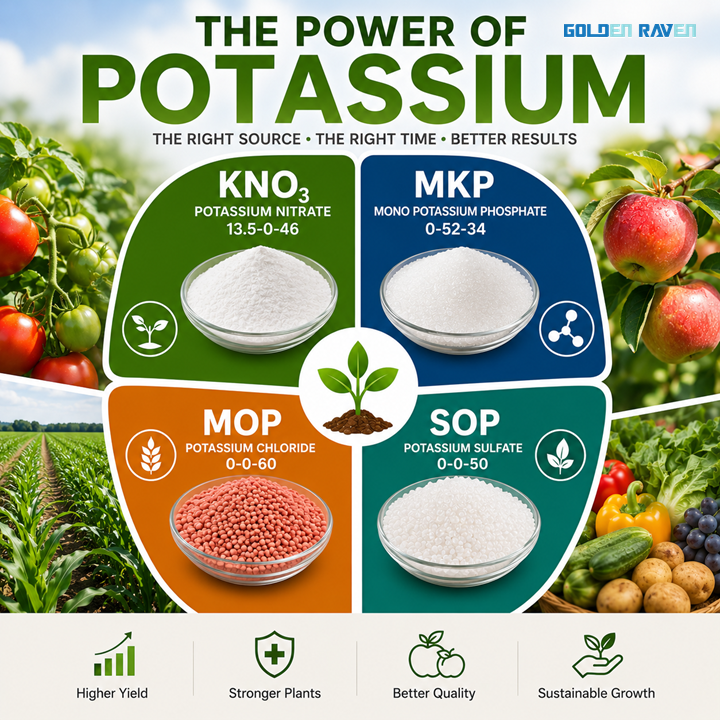
Monopotassium phosphate (MKP, KH₂PO₄) is a fully water-soluble, chloride-free fertilizer, typically supplied as 0-52-34: 52% phosphorus pentoxide (P₂O₅) and 34% potassium oxide (K₂O). It provides phosphorus and potassium without adding nitrogen, making it useful when these nutrients are needed while nitrogen inputs must be controlled.
MKP is widely used in fertigation and foliar feeding. Appropriate applications can support root establishment and fruit quality, while foliar feeding supplements the crop’s main fertilization program. Its effectiveness depends on nutrient demand, application timing, and growing conditions.
Choose mixing partners carefully
Tank mixing can reduce application work, but compatibility depends on the exact formulations, concentrations, water quality, and final solution pH.
Mixing partner | Practical guidance |
Urea and other compatible nitrogen fertilizers | May be combined with MKP when nitrogen is needed. For foliar sprays, use a suitable grade and consider the total fertilizer concentration. |
Boron and molybdenum fertilizers | Check the product formulation and recommended rate. Products with different nutrient contents cannot be used interchangeably at the same dilution. |
Chelated micronutrients | Prefer suitable chelated forms of iron, manganese, zinc, and copper. Chelation improves compatibility, but the exact mixture still requires verification. |
Calcium and magnesium fertilizers | Keep separate from MKP in concentrated stock solutions. Use separate tanks or application times unless the supplier specifically confirms compatibility. |
Pesticides and growth regulators | Mix only when permitted by the relevant labels and supported by compatibility information for the exact products. |
MKP supplier guidance recommends separating calcium and magnesium fertilizers and using chelated forms of several metal micronutrients. A product described as “organic,” “sugar alcohol,” or “chelated” should not automatically be assumed compatible.
Avoid common mixing mistakes
1. Combining MKP with strongly alkaline products
Lime, alkaline amendments, and some crop protection products can substantially change solution chemistry. Avoid unverified combinations that may cause precipitation or reduce product performance.
2. Adding carbonate or bicarbonate products without checking compatibility
These materials can neutralize acidity, release carbon dioxide, and alter solution pH. They should not be treated as routine MKP mixing partners.
3. Assuming all micronutrient products behave alike
Unchelated metal salts can react with phosphate. Compatibility also changes with concentration and water chemistry, so a clear dilute solution does not prove that a concentrated stock mixture is suitable.
4. Using fixed recipes for every crop
An MKP–urea or MKP–boron mixture should address a specific nutritional need. Adding more ingredients does not automatically improve absorption, flowering, yield, or crop safety.
5. Treating fertilizers as disease-control products
Brown sugar mixtures and fertilizer additions should not be promoted as reliable substitutes for registered disease-control programs. Claims that MKP or growth regulators prevent fungicide resistance also require specific evidence.
Prepare and apply the mixture correctly
Check all product labels and supplier compatibility guidance.
Conduct a jar test using the intended water, proportions, and mixing order.
Start with clean water and agitation; dissolve MKP completely before adding other products.
Follow the mixing sequence required by the pesticide formulations.
Check for sediment, separation, flocculation, or other visible changes before spraying.
A jar test checks physical compatibility; it does not establish crop safety or biological effectiveness. Where appropriate, test an unfamiliar mixture on a small crop area before wider application. Manufacturer compatibility services likewise distinguish physical tank mixability from other aspects of performance.
For foliar use, follow crop-specific rates and avoid hot conditions or severely stressed plants. Consider the combined concentration of every fertilizer in the tank rather than the MKP concentration alone.
Match MKP use to the nutrition program
MKP can be useful during both early growth and reproductive stages. Early application is not inherently harmful, and high solubility alone does not make it unsuitable for every soil application. Choose the timing, placement, and rate according to crop demand, soil conditions, and the overall fertilization plan.
Successful MKP use starts with a clear nutritional purpose, verified compatibility, and an appropriate application rate.

MKP Tank Mixing: Compatibility, Common Mistakes, and Best Practices


Comments