
What Is EDTA? How Metal Ions Stay Stable and Available?
- Yang Wu
- 2 days ago
- 2 min read

Ethylenediaminetetraacetic acid (EDTA) is an aminopolycarboxylic acid widely used as a powerful chelating agent. It binds metal ions through multiple coordination sites, forming highly stable complexes with metals such as iron (Fe), zinc (Zn), manganese (Mn), copper (Cu), calcium (Ca), and magnesium (Mg).
Chemical Formula: C₁₀H₁₆N₂O₈
CAS No.: 60-00-4
Molecular Weight: 292.24 g/mol
EDTA is typically supplied as a white crystalline solid, while its sodium salts and metal-chelated forms are widely used commercially because of their improved solubility and functionality.
Key Applications of EDTA
1. Agriculture
Agriculture is one of the most important application areas for EDTA, particularly in micronutrient fertilizers.
EDTA forms stable, water-soluble chelates with micronutrients such as Fe, Zn, Mn, and Cu, helping prevent these nutrients from reacting with other components or forming insoluble precipitates.
Common products include:
EDTA-Fe – iron source
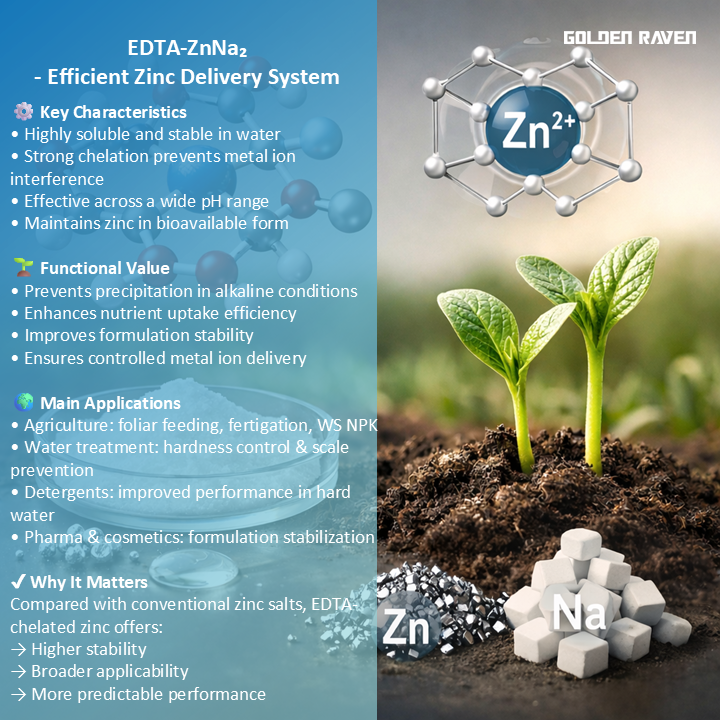
EDTA-Zn – zinc source
EDTA-Mn – manganese source
EDTA-Cu – copper source
These chelated micronutrients are widely used in fertigation, foliar application, hydroponics, and water-soluble fertilizers, improving nutrient stability and plant availability.
EDTA may also be used in certain soil-remediation processes to mobilize heavy metals. However, such applications require careful management because excessive metal mobilization may increase the risk of leaching.
2. Analytical Chemistry
EDTA is widely used in complexometric titration for determining metal-ion concentrations. Its predictable complex formation makes it particularly important in the analysis of Ca²⁺, Mg²⁺ and other metal ions, including water-hardness testing.
3. Water Treatment and Industrial Cleaning
EDTA sequesters unwanted metal ions in water and process systems, helping reduce scale formation, precipitation and metal-catalyzed reactions. It is therefore used in industrial cleaning, detergents and certain water-treatment formulations.
4. Food Industry
Approved EDTA salts, particularly calcium disodium EDTA, are used in certain food applications to bind trace metals that can accelerate oxidation, discoloration or quality deterioration. This helps maintain color, flavor and product stability.
5. Cosmetics and Personal Care
EDTA and its salts are commonly added to cosmetic and personal-care formulations to bind trace metal ions. This can improve formula stability and preservative performance and reduce undesirable changes in color, odor or texture.
6. Pharmaceuticals and Medicine
In pharmaceutical formulations, EDTA may act as a stabilizing or chelating agent, limiting degradation caused by trace metals.
Specific EDTA salts also have medical applications. For example, calcium disodium EDTA (CaNa₂EDTA) is used clinically as a chelating agent in certain cases of lead poisoning.
7. Textile and Industrial Processing
In textile processing, EDTA binds metal ions that may interfere with dyeing, bleaching and washing, helping improve process consistency and product quality.
Why Is EDTA Important?
The key value of EDTA lies in its ability to control metal-ion behavior.
By forming stable chelates, EDTA can:
Keep metal ions soluble → prevent precipitation → improve stability → enhance availability or process performance.
This unique property makes EDTA an important functional material across agriculture, analytical chemistry, water treatment, food processing, cosmetics, pharmaceuticals and industrial manufacturing.

What Is EDTA? How Metal Ions Stay Stable and Available?

Comments