
Global Fertilizer Market Weekly Update (CW33) | August 3 - 10, 2026
- Yang Wu
- 16 hours ago
- 2 min read

China Fertilizer Trade: Imports Surge, Exports Decline
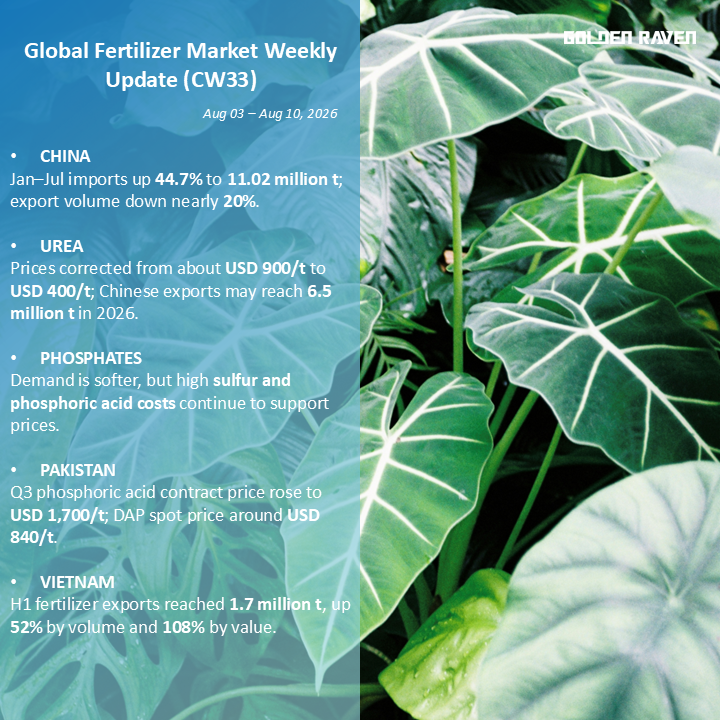
From January to July 2026, China imported 11.02 million tonnes of fertilizers, up 44.7% year on year, while import value rose 70.2% to USD 4.14 billion.
In July alone, imports reached 1.40 million tonnes, valued at USD 531 million, with an average CIF price of USD 378.89/tonne.
Meanwhile, China’s fertilizer exports during the first seven months declined by nearly 20%, highlighting a significant shift in trade flows.
Urea: Prices Expected to Stay Relatively Low
Global urea prices fell sharply in June and stabilized in July. Following the recovery of Chinese exports since late May, prices have retreated from around USD 900/tonne during the U.S.–Iran conflict to approximately USD 400/tonne.
China’s 2026 urea exports are forecast at 6.5 million tonnes, up from 4.6 million tonnes in 2025.
Global urea demand during April–June fell around 27% year on year, although purchasing activity is now showing a modest recovery.
Outlook
Sep-Oct: Potential rebound driven by Indian, Latin American and European buying.
Nov-Dec: Possible correction as new Russian and Nigerian capacity enters the market.
Q1 2027: Mild seasonal recovery as Europe and the Americas enter peak application periods.
Phosphate Fertilizers: Cost Pressure Remains Strong
Global phosphate demand has weakened as farmers prioritize nitrogen fertilizers.
The 2026 global phosphate fertilizer consumption forecast has reportedly been reduced to around 48.3 million tonnes, while DAP, MAP and TSP production is expected to remain below 60 million tonnes.
Sulfur shortages caused by disrupted Middle Eastern trade flows continue to push raw-material costs higher, reducing phosphate fertilizer operating rates across China, the U.S., India, Africa and Latin America.
China’s phosphate fertilizer export restrictions, previously expected to ease in August, have reportedly been extended into September. Full-year exports may remain around 700,000 tonnes, with broader export recovery potentially delayed until April-May 2027.
Turkey: China Leads Fertilizer Supply
China was Turkey’s largest fertilizer supplier in June, exporting approximately USD 25.5 million worth of products.
Russia ranked third with USD 19.9 million, behind Morocco. Russian fertilizer shipments to Turkey increased more than fourfold year on year in June, mainly driven by compound fertilizers.
Despite the June surge, Russia’s H1 fertilizer exports to Turkey declined around 3% year on year to USD 182.3 million.
Morocco remains a major supplier due to its extensive phosphate reserves and expanding fertilizer production capacity.
Pakistan: Phosphoric Acid Costs Push DAP Higher
International phosphoric acid prices have climbed to their highest level in roughly 16 quarters.
The Q3 2026 phosphoric acid contract price reached around USD 1,700/tonne, compared with USD 1,360/tonne in Q2.
Pakistan is particularly exposed because approximately 50% of its phosphoric acid supply depends on Middle Eastern imports.
Higher feedstock costs have also pushed international DAP spot prices to around USD 840/tonne, increasing cost pressure on Pakistani fertilizer producers and potentially farmers.
Vietnam Fertilizer Exports Surge
Vietnam exported approximately 1.70 million tonnes of fertilizers in H1 2026, generating USD 933 million.
Year on year:
Export volume increased 52%
Export value increased 108%
ASEAN remained Vietnam’s largest market, accounting for nearly 35% of export revenue.
Growth was particularly strong in:
Philippines: volume +106%, value +158%
Thailand: volume +326%, value +452%
South Korea: volume +36%, value +132%
Cambodian demand weakened, while Myanmar and Malaysia continued to grow steadily.
Global Fertilizer Market Weekly Update (CW33) | August 3 - 10, 2026


Comments